
25 Business Ideas for Women in India With Real Costs (2026)
The best business ideas for women in India are the ones you can start from home with Rs 5,000 to Rs 50,000, sell through WhatsApp and Instagram, and grow at your own pace: home baking, tiffin services, boutiques and reselling, mehendi and makeup, tuition, handmade gifting and online services. Below are 25 ideas with realistic start-up costs, the registrations each one actually needs, where the first customers usually come from, and the Busiqueens members who are already doing it.
This guide is written from inside a community of 8,400+ women entrepreneurs, most of whom started exactly this way: a phone, a skill and a first order from someone they knew. Every example is a real woman with a public page on busiqueens.com. Costs are typical ranges reported by members and suppliers in Kolkata and other Indian cities in September 2026; your city and your choices will move them up or down.
If you want the short version: pick the idea closest to a skill you already have, register for Udyam (free) and, for food, FSSAI (Rs 100 a year), take ten orders from people you know, and only then spend on packaging, branding or stock. If your budget is Rs 25,000 or less, start with our 15 business ideas for women at home, each with itemised costs and earning estimates.
How we chose these 25 ideas
Three filters. First, the business can start from home, because that is how most of our members start. Second, the first Rs 50,000 is enough to begin, and many need far less. Third, we know women who run it today, so the costs and the first-customer routes below come from real experience, not from a brochure. Ideas that need a shop, a licence that takes months, or a large machine are left out.
The ideas are grouped the way the Busiqueens directory is grouped, so you can see who is already listed in each field.
All 25 ideas at a glance
| Idea | Typical start-up cost | First customers come from | Must-have registration |
|---|---|---|---|
| 1. Home bakery | Rs 15,000 to 40,000 | Family, WhatsApp status, school groups | FSSAI basic |
| 2. Tiffin service | Rs 10,000 to 25,000 | Offices, PGs, hostels near you | FSSAI basic |
| 3. Home chef and small catering | Rs 15,000 to 50,000 | Family functions, kitty parties | FSSAI basic |
| 4. Pickles, masalas and preserves | Rs 5,000 to 20,000 | Neighbours, exhibitions, Instagram | FSSAI basic |
| 5. Chocolates and festive sweets | Rs 8,000 to 25,000 | Diwali, Eid and wedding orders | FSSAI basic |
| 6. Boutique and reselling from home | Rs 20,000 to 50,000 | Instagram, WhatsApp broadcast lists | Udyam (optional) |
| 7. Modest wear and hijab brand | Rs 15,000 to 40,000 | Instagram, community groups | Udyam (optional) |
| 8. Tailoring and alterations | Rs 10,000 to 30,000 | Neighbourhood, boutiques nearby | None to start |
| 9. Kids wear | Rs 15,000 to 40,000 | Mothers in your circle, school groups | Udyam (optional) |
| 10. Bridal and occasion wear on order | Rs 20,000 to 50,000 | Referrals from brides, mehendi artists | None to start |
| 11. Mehendi artist | Rs 3,000 to 10,000 | Weddings in your circle, Instagram reels | None |
| 12. Freelance makeup artist | Rs 25,000 to 60,000 | Bridal referrals, salons, Instagram | None |
| 13. Home salon and beautician | Rs 15,000 to 40,000 | Neighbourhood women, festival season | Trade licence in some cities |
| 14. Makeup or mehendi academy | Rs 10,000 to 30,000 | Your own clients and followers | None |
| 15. Home tuition | Rs 2,000 to 10,000 | Parents in your building, school groups | None |
| 16. Online coaching | Rs 5,000 to 20,000 | Facebook groups, LinkedIn, referrals | None |
| 17. Play school or activity centre | Rs 50,000 upwards | Parents nearby, housing societies | Local registration |
| 18. Tutor placement consultancy | Rs 5,000 to 15,000 | Parents and teachers you know | Udyam (optional) |
| 19. Candles and fragrance | Rs 8,000 to 25,000 | Gifting season, exhibitions | Udyam (optional) |
| 20. Gift hampers | Rs 10,000 to 30,000 | Weddings, corporate Diwali orders | FSSAI if food is included |
| 21. Resin art and handmade decor | Rs 8,000 to 20,000 | Instagram, exhibitions | None |
| 22. Handmade jewellery | Rs 5,000 to 25,000 | Instagram, college groups, exhibitions | None |
| 23. Yoga and fitness coaching | Rs 5,000 to 30,000 | Neighbourhood, online batches | Certification recommended |
| 24. Social media management and content | Rs 5,000 to 15,000 | Small businesses in your own network | None |
| 25. Photography and design services | Rs 30,000 to 1 lakh | Events, other women entrepreneurs | None |
Food from home: five ideas
Food is where most women in our community started, because the skill is already in the house and the first customers are already in the phone. The rule for all five: get the FSSAI basic registration first (online at FoSCoS, Rs 100 a year, usually issued within a week), print the number on your labels, and keep a simple order book from day one. Verified food businesses are listed under Food, Bakes and Catering.
1. Home bakery
Cakes, cupcakes, brownies and cookies made to order. You need an OTG or a convection oven (Rs 8,000 to 15,000), tins, a hand mixer, a weighing scale and boxes. Price by the kilo for cakes and by the piece for the rest, and always cost the ingredients before you quote.
- Start-up cost: Rs 15,000 to 40,000, less if you already own an oven.
- Registration: FSSAI basic; Udyam once you are regular.
- First customers: birthdays in the family, your WhatsApp status, the school parents group.
- Members doing it: Shagufta Nazrul of The Real Cakes by Shagufta, Zaira Hossain of The Cupcake Darling and Afifa Parween of The Baker’s Zia, all Awards 2026 nominees.
2. Tiffin service
Home-cooked lunch or dinner delivered to office workers, students and elderly customers near you. Start with one menu a day, ten customers and a fixed monthly price. Steel dabbas cost more up front but save you from buying disposables every day.
- Start-up cost: Rs 10,000 to 25,000 for dabbas, a bigger cooker and the first week of groceries.
- Registration: FSSAI basic.
- First customers: the PG, hostel or office block within two kilometres of your kitchen; one notice on their board is often enough.
- Members doing it: home chefs such as Sana Afreen of Zainab’s Kitchen and Tabassum Hossain of Chatkara Bites.
3. Home chef and small catering
Party orders for 20 to 100 people: biryani, kebabs, a regional thali, a dessert table. Margins are better than tiffin but the work comes in bursts, so most home chefs pair it with a small weekly menu.
- Start-up cost: Rs 15,000 to 50,000, mostly large vessels, a second burner and serving trays.
- Registration: FSSAI basic; a state licence only above Rs 12 lakh turnover.
- First customers: family functions, kitty parties and office Friday lunches.
- Member doing it: Dr Archana Burman of Mayer Henshel, who cooks Bengali home food for orders.
4. Pickles, masalas and preserves
Shelf-stable products travel well, so this is the food idea that scales beyond your city by courier. Family recipes, clean glass jars and honest labels (ingredients, date, weight, your FSSAI number) are the whole business at the start.
- Start-up cost: Rs 5,000 to 20,000 for jars, labels, raw material and a sealing machine.
- Registration: FSSAI basic. Weights and Measures labelling rules apply once you sell packaged goods.
- First customers: neighbours, then exhibitions such as AAINA, then Instagram.
5. Chocolates and festive sweets
Handmade chocolates, dry-fruit sweets and festive boxes sell in waves: Diwali, Eid, Raksha Bandhan, Christmas, weddings. Plan production around the calendar and take advance bookings four weeks ahead.
- Start-up cost: Rs 8,000 to 25,000 for moulds, compound or couverture, boxes and a small fridge shelf.
- Registration: FSSAI basic.
- First customers: corporate Diwali gifting is the biggest single order most chocolatiers get; ask every working friend.
- Member doing it: Mushkan Afreen of Mushkan Cake and Bakery.
Fashion and boutiques: five ideas
Clothing is the second biggest group in our directory, and the one with the widest range of start-up costs. You can begin as a reseller with zero stock and grow into your own label. See who is listed under Fashion and Boutiques.
6. Boutique and reselling from home
Kurtis, sarees and suits sourced from wholesale markets (Burrabazar in Kolkata, Surat, Jaipur) or from manufacturers who ship on order. Start as a reseller: post the catalogue, collect orders, then buy. Move to holding stock only for your best sellers.
- Start-up cost: Rs 20,000 to 50,000 for a first stock of 30 to 50 pieces, packaging and a ring light for photos. Reselling on order needs under Rs 5,000.
- Registration: Udyam when you want a current account or a loan; GST only when marketplaces need it.
- First customers: a WhatsApp broadcast list of 50 women you know, refreshed every Friday.
- Members doing it: Saimi Khan of Manal Fashion, Sana Syed of Tanposh by Sana and Umam Kainat of GulPosh Fashion.
7. Modest wear and hijab brand
Abayas, hijabs, prayer sets and modest office wear have a loyal, under-served market in most Indian cities. Fabric quality and honest colour photos matter more than variety in the first year.
- Start-up cost: Rs 15,000 to 40,000 for fabric, a tailor’s first batch and packaging.
- Registration: Udyam (optional at the start).
- First customers: community groups, mosque and college circles, Instagram reels showing drape and fabric.
- Members doing it: Sultana Begum of Ziya Collection and Sk Afreen Zaira of Itz Hijabi Trends.
8. Tailoring and alterations
Every neighbourhood needs a reliable tailor for blouses, alterations and school uniforms, and most are overbooked before every festival. If you can stitch, this business starts the day you say yes to the first neighbour.
- Start-up cost: Rs 10,000 to 30,000 for a good machine, an interlock and a cutting table.
- Registration: none needed to start.
- First customers: your building, then the boutiques nearby who need stitching capacity.
- Member doing it: Aasiya Khanum of Aasiya Tailoring.
9. Kids wear
Frocks, ethnic sets and festive wear for children under ten. Parents reorder every season because children outgrow clothes, so repeat business is built in.
- Start-up cost: Rs 15,000 to 40,000.
- Registration: Udyam (optional).
- First customers: mothers in your own circle and the school WhatsApp group; a twinning set for mother and daughter is a reliable first hit.
10. Bridal and occasion wear on order
Designed and stitched to measure, with a karigar or two on piece rate. Higher ticket, longer lead time, and the referrals come from the wedding circle: mehendi artists, makeup artists and the last bride.
- Start-up cost: Rs 20,000 to 50,000 for samples, a portfolio shoot and fabric deposits.
- Registration: none to start; trademark your label once it is known.
- Members doing it: Nikhat Parveen of Fatima Fashion and Rubina Kausar of ShimmerS.
Beauty, makeup and mehendi: four ideas
These are skill businesses: your hands are the stock. The start-up cost is a kit and a portfolio, and the wedding season decides your calendar. Verified artists are listed under Beauty, Makeup and Mehendi.
11. Mehendi artist
The lowest-cost business on this list and one of the most crowded, which is why a clear style and a good reel matter. Bridal mehendi in a metro pays several thousand rupees a hand; guest mehendi at functions pays per person and fills the calendar.
- Start-up cost: Rs 3,000 to 10,000 for cones, a practice hand and a ring light.
- Registration: none.
- First customers: weddings in your own circle, then Instagram reels of finished hands with the bride’s permission.
- Members doing it: nine mehendi artists are Awards 2026 nominees, including Naureen Sobhani, Anisha Zahid and Alisha Khanam of Henna by Alisha. Browse them under Mehendi Artists.
12. Freelance makeup artist
Bridal, party and shoot makeup at the client’s home or venue. The kit is the main cost, and a short professional course pays for itself quickly through confidence and referrals.
- Start-up cost: Rs 25,000 to 60,000 for a professional kit and a course.
- Registration: none.
- First customers: friends’ weddings and pre-wedding shoots, then partnerships with a mehendi artist and a photographer.
- Members doing it: Fauzia Hamid of Blush by Fauzia and Shagufta Parveen of Makeup by Shagufta.
13. Home salon and beautician
Threading, waxing, facials and hair services from a spare room or at the customer’s home. Steady, repeat income every four to six weeks, with festival months as the peak.
- Start-up cost: Rs 15,000 to 40,000 for a chair, a trolley, a steamer and products.
- Registration: some municipal corporations ask for a trade licence for a salon at home; check with your ward office.
- Members doing it: Sadaf Arshad of Shazfa Makeover and Ayesha Parveen of Ayesha Makeover.
14. Makeup or mehendi academy
Once you have two or three years of work behind you, teaching adds a second income with no extra kit. Weekend batches of five to eight students, a certificate you design yourself, and your own clients as the first students.
- Start-up cost: Rs 10,000 to 30,000 for practice kits and a printed manual.
- Member doing it: Samsad Begum of Samsad’s Makeup Studio and Academy.
Education and coaching: four ideas
Teaching businesses need the least capital of all and the most patience. Fees are paid monthly in advance, so cash flow is predictable. Verified teachers and coaches are under Education and Coaching.
15. Home tuition
School subjects for classes 1 to 12, in batches of four to six at your dining table. Results bring the next batch, so start with one subject you are genuinely strong in.
- Start-up cost: Rs 2,000 to 10,000 for a whiteboard, chairs and books.
- Registration: none.
- First customers: parents in your building and the school group; offer a free first week.
- Member doing it: Noor Fatma, a teacher and Awards 2026 nominee.
16. Online coaching
Spoken English, exam preparation, a language, Quran or music classes over video call. Your market is all of India, and batches can run early morning or late evening around your household.
- Start-up cost: Rs 5,000 to 20,000 for a headset, a ring light, a stable connection and a paid video tool.
- Registration: none; Udyam helps when you invoice institutions.
- First customers: Facebook groups for parents and learners, LinkedIn for professional skills, referrals from every student.
17. Play school or activity centre
A morning play school or an after-school art, dance and activity centre in a spare room or a small rented space. The highest start-up cost in the education group, and the one with the most regulation, so plan it properly.
- Start-up cost: Rs 50,000 upwards for furniture, toys, safety fittings and a helper’s salary.
- Registration: local registration and safety norms vary by state and city; ask your municipal office before you sign a lease.
- First customers: parents within walking distance and the housing societies around you.
18. Tutor placement consultancy
Connecting parents who need a home tutor with vetted teachers, for a placement fee or a first-month share. It runs on trust and a good phone book, not on capital.
- Start-up cost: Rs 5,000 to 15,000 for a simple website or Instagram page and a phone number.
- Registration: Udyam (optional).
- Member doing it: Priyam Chakraborty founded Prisha Edu in Kolkata in 2021 exactly this way, and was on the cover of Busiqueens Magazine 4.0. Read her story.
Handmade, decor and gifting: four ideas
Handmade products sell on story and photographs. Exhibitions such as AAINA, the Busiqueens exhibition, are where most makers meet their first hundred customers face to face. See who is listed under Home Decor and Gifting and Jewellery and Accessories.
19. Candles and fragrance
Soy and gel candles, wax melts and room fragrance. Low material cost, high gifting demand from October to February, and a product that photographs beautifully.
- Start-up cost: Rs 8,000 to 25,000 for wax, wicks, fragrance oils, moulds and jars.
- Registration: Udyam (optional).
- First customers: Diwali gifting orders from working friends, then exhibitions and Instagram.
20. Gift hampers
Curated boxes for weddings, baby showers, Diwali and corporate gifting. You buy from other small makers (often other Busiqueens members), add packaging and presentation, and sell the convenience.
- Start-up cost: Rs 10,000 to 30,000 for boxes, fillers, ribbons and a first set of sample hampers.
- Registration: FSSAI basic if the hamper includes food you have made or repacked.
- Members doing it: Farheen Perveen of F7 Cake and Hampers, Sana and Sameen of Little Charms and Meraj Sultana Khan of Al-Unyk Collections.
21. Resin art and handmade decor
Resin trays, clocks, name plates, preserved-flower frames and wall decor. Custom orders (a wedding invitation preserved in resin, a nameplate for a new flat) carry the best margins.
- Start-up cost: Rs 8,000 to 20,000 for resin, pigments, moulds, a heat gun and safety gear.
- Registration: none.
- Members doing it: resin artist Firdous Parveen, and home decor sellers Shama Parveen of Sha’s Collection and Farhin of Afan Adil Enterprise.
22. Handmade jewellery and accessories
Oxidised, thread, polymer clay and beaded jewellery, plus bags and clutches. Small parcels, easy courier, and college and office women as a repeat audience.
- Start-up cost: Rs 5,000 to 25,000 for materials, tools and a photo backdrop.
- Registration: none; hallmarking rules apply only if you sell gold.
- Members doing it: Marium Tarique of The Mannat Studio and Sheeba Khan of Unique Collection.
Wellness and services: three ideas
Service businesses have no stock and no wastage, and they grow on reputation. Qualified professionals such as doctors, nutritionists and counsellors are listed under Health and Wellness; designers, marketers and photographers under Professional Services.
23. Yoga and fitness coaching
Morning batches in a park or a hall, online batches for women who cannot leave the house, and one-to-one sessions for postnatal or senior clients. A recognised certification is worth the fee: clients ask.
- Start-up cost: Rs 5,000 to 30,000, most of it the certification and mats.
- First customers: your neighbourhood and one free trial week online.
24. Social media management and content writing
Every small business on this list needs someone to post, reply and write. If you are that person for three or four of them, you have a business. Charge a monthly retainer, not per post.
- Start-up cost: Rs 5,000 to 15,000 for a laptop upgrade and a design tool subscription.
- Registration: none; Udyam when clients want invoices.
- First customers: other women entrepreneurs in your own network, which is one reason to join a community and start networking early.
25. Photography and design services
Product photography for makers, event coverage for family functions, logo and packaging design. Other women entrepreneurs are your customers, and they are easy to find in one place.
- Start-up cost: Rs 30,000 to 1 lakh for a camera or a good phone rig, lights and software.
- First customers: the bakers, boutiques and jewellery makers above; offer a launch shoot at a fair price and ask for the tag.
How to pick the right idea for you
Answer four questions honestly and the list gets short quickly.
- What can you already do well? A skill you have practised for years beats a trend you would have to learn. Most successful members started with something they were already known for at home.
- How many hours a day are really free? Tiffin and tuition need the same hours every day; baking, mehendi and gifting come in bursts around festivals and weddings.
- Do you want to make, teach or sell? Making needs space and stock, teaching needs patience and a schedule, reselling needs a phone book and follow-up.
- Who are the first ten people who would buy from you? If you can name them, start. If you cannot, choose an idea where you can.
Registrations in the right order
Women often delay starting because they think a business needs a pile of paperwork. It does not. Do these in this order and only when each one is needed.
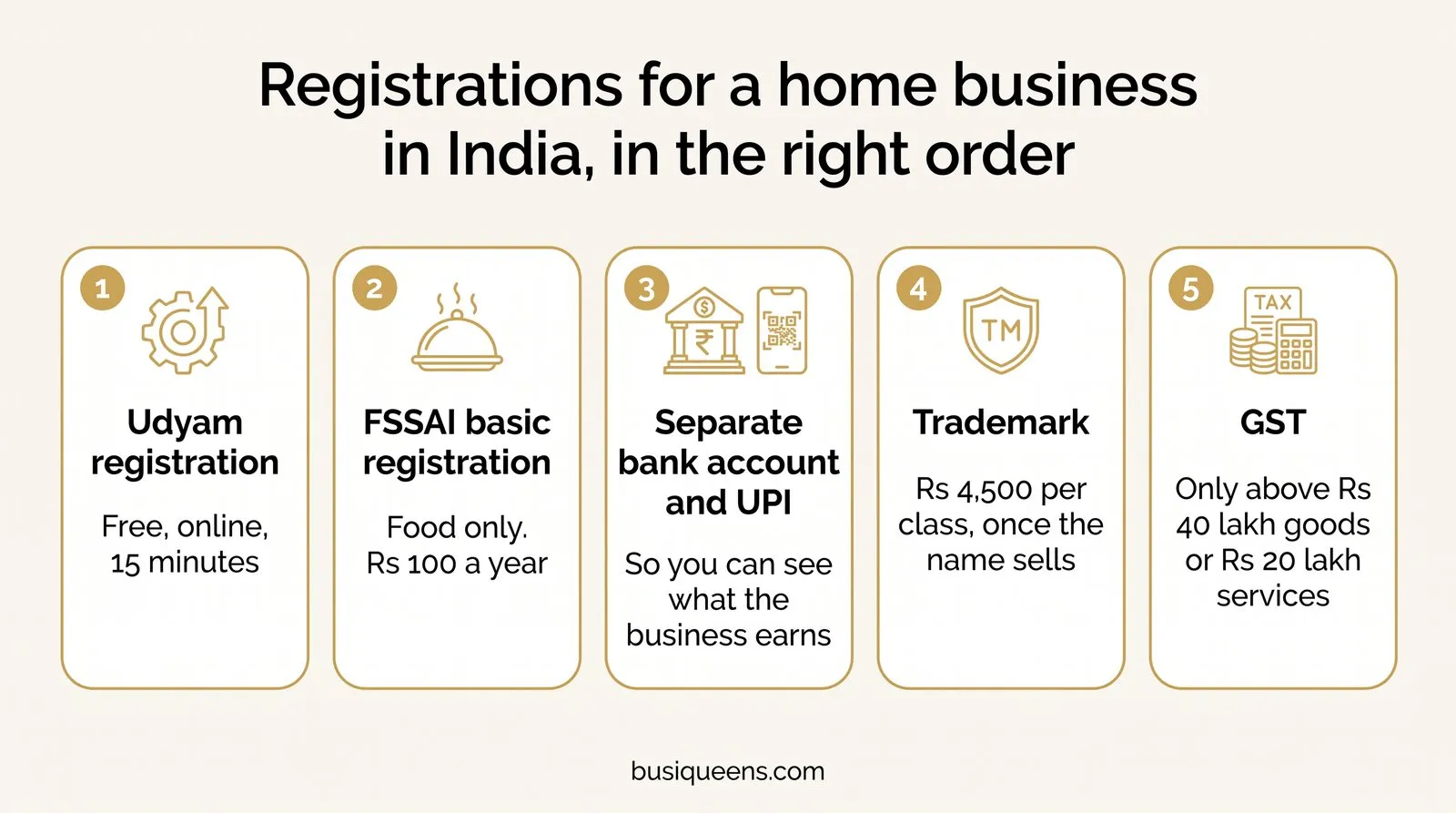
- Udyam registration, free, at the government portal. It makes you an official micro enterprise, which banks and schemes recognise.
- FSSAI basic registration, Rs 100 a year, only if you handle food.
- A separate bank account and UPI ID for the business, even if it is a savings account in your name, so you can see what the business earns.
- A trademark for your brand name, Rs 4,500 per class, once the name is bringing customers and you would mind losing it.
- GST only when you cross the threshold or when a marketplace insists.
Our guide to how women entrepreneurs are redefining success covers the government schemes that sit behind these registrations.
How to get your first ten customers without a marketing budget
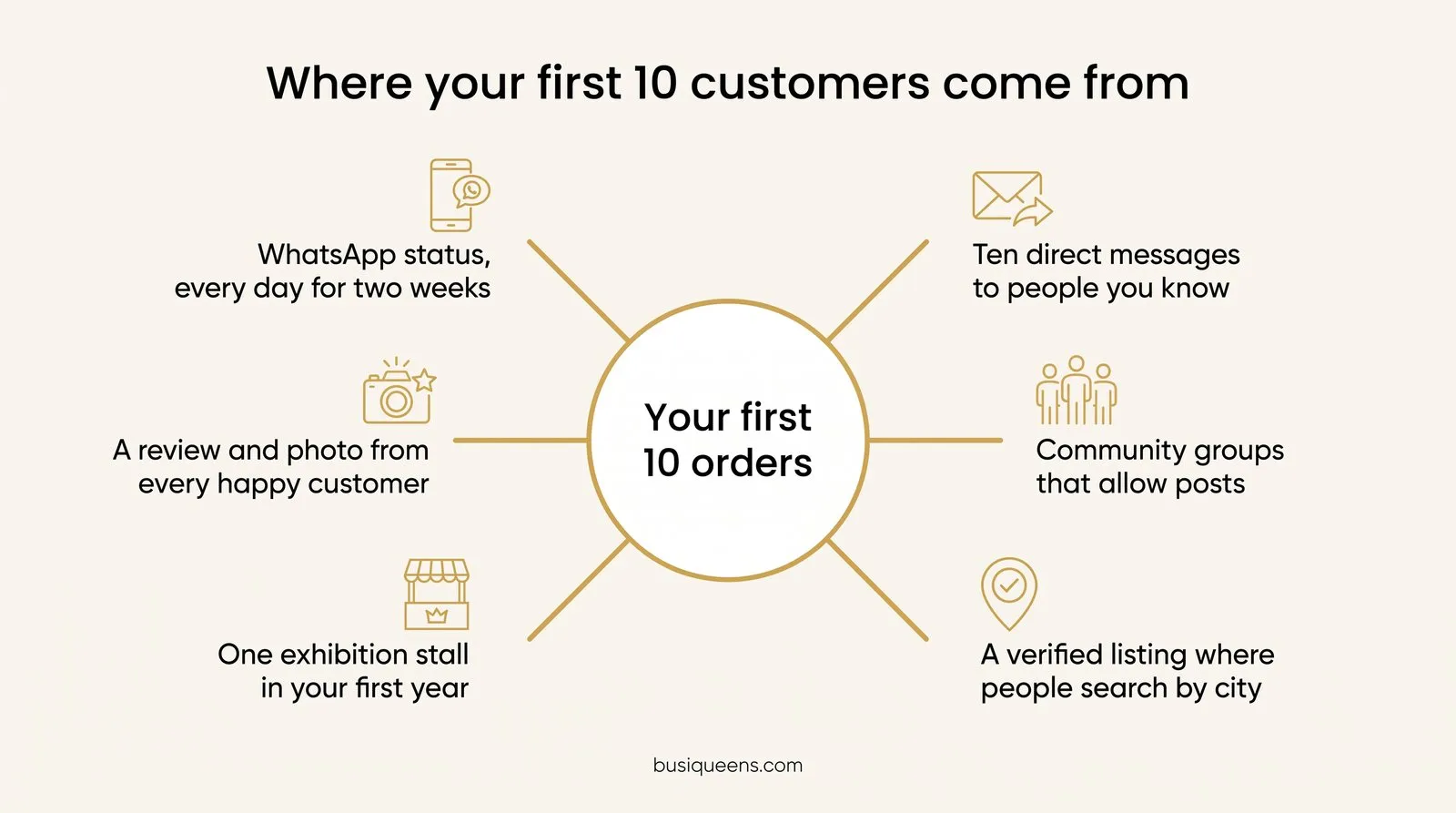
- Put the product on your WhatsApp status every day for two weeks, with a price and a way to order. Most first orders come from there.
- Tell the ten people you named above directly, one message each, not a broadcast.
- Post in community groups where the rules allow it. The Busiqueens Facebook group has more than 8,400 women who buy from each other.
- Get listed where people search. A verified listing on Busiqueens puts you in the directory by category and city for Rs 999 a year, with a certificate and a QR code you can print on your packaging.
- Take a stall at one exhibition in your first year. Members who exhibit at AAINA usually come back with more repeat customers than any online campaign brings them.
- Ask every happy customer for a review and a photo. Reviews on your listing and your Instagram do the selling for you.
Money: how much to keep aside, and when to borrow
Start with what you have. Keep enough to buy raw material for the first three weeks of orders, and put profit back into the business before you spend it. Borrow only when you have repeat orders you cannot fulfil: a Mudra Shishu loan of up to Rs 50,000 needs no collateral and is meant for exactly this stage, and the Kishore and Tarun tiers go up to Rs 10 lakh once you have a track record. Never take a loan to buy stock for a business that has not sold anything yet.
Balancing the business with the house is the other kind of budget. Our members’ advice on balancing work and life as a woman entrepreneur is worth reading before you start, not after.
Where Busiqueens fits in
Busiqueens is India’s community and verified business directory for women entrepreneurs, started in Kolkata in 2021. Members list their businesses in the directory, meet at meetups and the AAINA exhibition, are recognised at the annual Busiqueens Awards and are featured in the Busiqueens Magazine. Every woman named in this guide is a real member with a public page, and every business in the directory is checked by a real person before it goes live.
If one of these 25 ideas is already your business, list it. If you are still choosing, join the Facebook group, ask the women who are doing it, and come back to this page when you have your first ten orders.
Conclusion
You do not need a shop, a loan or a company to start a business in India. You need a skill people already ask you for, ten customers you can name, and the two or three registrations your idea actually requires. Everything else, from packaging to a trademark, can wait until the orders are coming in.
- Start where your skill is: food, fashion, beauty, teaching, handmade or a service you already do well.
- Budget honestly: most of these 25 ideas start between Rs 5,000 and Rs 50,000, and several under Rs 10,000.
- Register only what you need: Udyam (free) for everyone, FSSAI (Rs 100 a year) for food, a trademark and GST later.
- Sell to people you know first: WhatsApp status, direct messages and one exhibition beat paid ads in year one.
- Get found: a verified listing and honest reviews do the marketing while you do the work.
Sources
- Udyam Registration portal, Ministry of MSME: udyamregistration.gov.in
- FSSAI FoSCoS fee structure (basic registration Rs 100 a year): foscos.fssai.gov.in
- Pradhan Mantri Mudra Yojana loan categories: mudra.org.in
- Trade Marks Rules 2017 fee schedule (Rs 4,500 per class for individuals, startups and MSMEs): ipindia.gov.in
- NITI Aayog, Decoding Government Support to Women Entrepreneurs in India (2023): women own about 20% of enterprises in India.
Frequently asked questions
Which business is best for a housewife with low investment in India?
Food from home (a home bakery, tiffin service, pickles or chocolates), tailoring, mehendi, home tuition and reselling clothes on WhatsApp all start under Rs 25,000, and several under Rs 10,000. The best one is the one that uses a skill you already have and that ten people you know would pay for this month.
Which business can I start from home with Rs 10,000?
Mehendi (Rs 3,000 to 10,000), home tuition (Rs 2,000 to 10,000), pickles and masalas (from Rs 5,000), handmade jewellery (from Rs 5,000), online coaching, social media management, and reselling kurtis or sarees on order, which needs almost no stock. Keep the first Rs 10,000 for material and packaging, not for advertising.
Do I need GST to run a home business in India?
Not until your turnover crosses Rs 40 lakh a year for goods or Rs 20 lakh for services, if you sell directly through WhatsApp, Instagram or your own site. Marketplaces such as Amazon and Flipkart usually ask for a GSTIN before they onboard a seller. Udyam registration is free and separate from GST.
Is FSSAI registration compulsory for a home bakery or tiffin service?
Yes. Any food business in India needs FSSAI registration. For turnover under Rs 12 lakh a year the basic registration costs Rs 100 a year, is applied for online at FoSCoS and is usually issued within a week. Print the 14-digit number on your labels and bills.
How do I get customers for a home business without a marketing budget?
Start with the people who already trust you: your WhatsApp status every day for two weeks, direct messages to ten people, community groups that allow posts, and one exhibition stall in your first year. Get listed where customers search by category and city, and ask every happy customer for a review and a photo.
Can I run a business from home in India without a shop or a trade licence?
Yes, for most of the 25 ideas here. Food needs FSSAI registration, a salon at home may need a trade licence from your municipal corporation, and a play school needs local registration. Baking, tailoring, mehendi, tuition, handmade products, reselling and online services can start from home with no licence beyond the free Udyam registration.