Women Entrepreneurship in India: Facts, Challenges, Stories
Women entrepreneurs in India: official numbers, key challenges, schemes like Mudra and Stand-Up, and simple first steps to start your own business.
Women entrepreneurs in India run millions of businesses, and most of them are small units started at home. The Sixth Economic Census counted 8.05 million establishments run by women, and Press Information Bureau (PIB) figures show women hold 67% of Mudra loans. Finance, time and networks are still the main hurdles, and official support exists for each.
This guide shares what official sources say about women entrepreneurship in India, the challenges that still hold women back, the schemes that can help, and simple first steps to start or grow a business on your own terms.
Last updated: 20 November 2026.
What is women entrepreneurship in India?
Women entrepreneurship means women starting, owning and running their own businesses. It covers a home tiffin service, a boutique, a beauty parlour, a tuition centre, a handloom label and a technology startup alike. What these women entrepreneurs share is that they take the risk, make the decisions and keep the business going.
In India, most of this work happens in very small units. According to NITI Aayog’s report on government support to women entrepreneurs, women own only about 20% of all enterprises, and 82% of these women-led enterprises are micro units run as sole proprietorships. Most sit in the informal sector, which means no registration, no business bank account and little access to formal credit.
That is why entrepreneurship for women in India is as much about small, steady steps as it is about big startup stories. A registered home business with a clear price list and a loyal customer base is a real enterprise, and it counts.
How many women entrepreneurs are there in India?
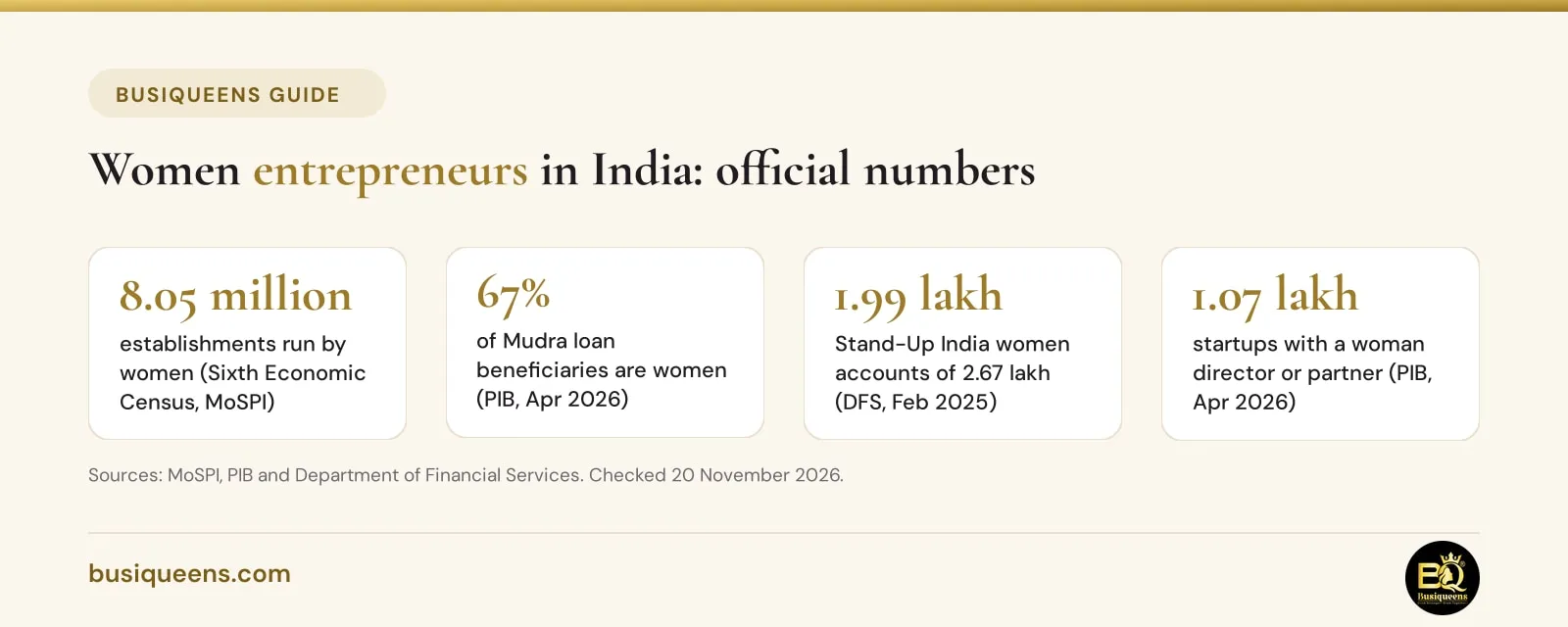
There is no single official count, because different surveys measure different things. Here is what the official sources say, with the date each one refers to.
| Measure | Figure | Official source |
|---|---|---|
| Establishments run by women entrepreneurs | 8.05 million of 58.5 million, about 13.76% | Sixth Economic Census, MoSPI |
| Share of enterprises owned by women | About 20%, with 82% of them micro units | NITI Aayog report |
| Women among Mudra loan beneficiaries | 67% | PIB, 8 April 2026 |
| Stand-Up India accounts held by women | 1.99 lakh of 2.67 lakh accounts sanctioned (as on 28 February 2025) | Department of Financial Services |
| Recognised startups with at least one woman director or partner | More than 1.07 lakh, about 48% of recognised startups | PIB, 17 April 2026 |
The census also shows where women’s businesses sit. According to MoSPI, the top activities by number of establishments owned by women entrepreneurs were agriculture (34.3%), manufacturing (29.8%) and trade (18.23%). In plain words, a large share of women’s enterprises are livestock, food, tailoring, crafts and small shops.
According to the NITI Aayog report, there is also a note of caution: studies suggest that 10% to 30% of enterprises registered as women-owned are often not actually run by women. So the real picture of women entrepreneurship in India is both bigger at the informal end and smaller at the formal end than the headline numbers suggest.
Who should read this guide?
This guide is for any woman in India who runs a business or wants to start one. That includes the homemaker who sells pickles to neighbours, the graduate thinking about a design studio, the working woman planning a side business and the founder who already has a team.
It is also for families, mentors and community groups who want to support a woman entrepreneur and need a clear, honest picture of the facts, the schemes and the first steps.
If you are just exploring ideas, read our list of business ideas for women in India with real costs alongside this guide.
What will running your own business get you?
Money matters, and a business should earn. But women entrepreneurs are also redefining success by looking beyond the profit line. Many measure it by control over their time, the respect of their family, the people they employ and the change they bring to their neighbourhood.
Here is what running your own business can give you, with honest effort and time:
- Your own income. Money you earn and decide how to use.
- Flexible hours. Work that fits around children, parents or studies, especially for home-based businesses.
- Skills that last. Pricing, selling, accounts, negotiation and leadership grow with every order.
- Confidence and identity. Many women say the business gave them a voice at home and outside.
- Jobs for others. As you grow, you can hire other women from your area.
There are no promises in business. Some months will be slow, and some ideas will not work. What you build is a skill set and a reputation, and those stay with you even if one product fails.
Success beyond profit
A key part of this new idea of success is social impact. Many women entrepreneurs build businesses that help their communities, address inequality or support people who are often left out.
Whether it is through inclusive hiring, fair pay to artisans or products that serve a real need, these women show that success can be measured by the good a company does, not only by its bottom line.
Sustainability is another part of it. From reusable packaging to local sourcing and less waste, many women-led businesses think about the environment from day one. That builds a company that lasts longer than one season’s trend.

Which business ideas suit women entrepreneurs in India?
The best idea is usually the one closest to what you already do well. A skill you have practised for years gives you a head start on quality, and quality is what brings customers back.
Food is the most common starting point: home bakeries, tiffin services, pickles, snacks, sweets and festive hampers. Fashion and craft come next: tailoring, boutiques, embroidery, jewellery, block printing and home decor. Services are a third group: beauty and mehendi, tuition and coaching, event planning, photography, bookkeeping and social media management.
Before you choose, ask three questions. Will people near you pay for this every month, not only once? Can you make or deliver it with the time and space you have? Can you charge enough to cover every cost and still earn?
If the answer to all three is yes, test it with a small batch.
Remember that some trades need licences. Food businesses need FSSAI registration or a licence, and cosmetics or regulated services have their own rules. Check the official portal for your trade before you sell widely.
What challenges do women entrepreneurs face in India?
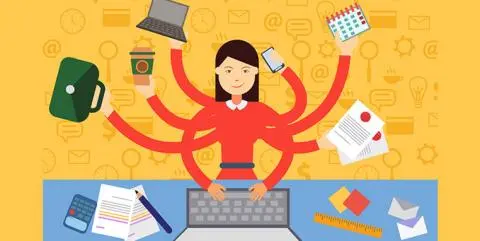
Women entrepreneurs still face problems that ask them to be strong and flexible every day. These are the ones that come up again and again.
Access to money
Getting working capital is the biggest hurdle for most women-owned units. Many women have no property in their own name to offer as security, no credit history and no formal business records. That is one reason most women’s businesses stay micro.
Collateral-free schemes exist for exactly this gap, and we cover them below. A clean bank record, a simple business plan and a registration certificate make any loan conversation easier.
Bias and doubt
Even though things have improved, many women still meet doubts about their ability to lead, especially in fields like manufacturing, technology or trading. These biases can be subtle, like a supplier who wants to speak to “the man of the house”, or open, like being refused a meeting.
Bias can hurt confidence and slow growth. Many women answer it with good work, clear records and a network of people who back them.
The double load of work and home
Balancing business and family tasks is hard, especially when women are expected to do most of the housework and care work. The demands of a business and the expectations of family can pull in different directions.
Planning, sharing tasks at home and setting fixed work hours help. We return to this in the section on work and life below.
Small networks and limited mobility
Customers, suppliers and mentors often come through networks. Women with little time or safe travel options can find it hard to attend trade fairs, meet buyers or visit banks. Online selling, community groups and verified directories close part of that gap.
Male-dominated sectors
Technology, banking and manufacturing are still mostly male-dominated. Women in these areas often have to work harder to show they are qualified and to get into the networks where deals are made. Still, more women are entering these fields every year, and they are proving the old ideas wrong.
List your business on Busiqueens
Get a verified business page with your photos, services and a WhatsApp button, so customers in Kolkata and across India can find and contact you.
Rs 999, paid only after your listing is approved.
List your businessEvery listing is checked by our team before it goes live.
How are women entrepreneurs redefining leadership?
Women entrepreneurs’ leadership styles are becoming better known for being effective. A collaborative attitude, clear communication and a focus on inclusion often set women apart as leaders.
Women leaders are known for bringing people together, making the workplace a good place to be and using different points of view to spark new ideas. These traits matter when markets change quickly and good people skills decide who adapts.
Many women-led companies also welcome different kinds of people. They push for staff from a wide range of backgrounds, experiences and points of view, which improves decisions and makes problem-solving easier.
Empathy and emotional intelligence are a big part of this style. Women business owners often pay close attention to their team’s needs, which builds trust, reduces conflict and keeps good people longer.
Emotional intelligence includes knowing yourself, respecting others and getting along with people. It helps women leaders handle difficult situations and guide their teams toward common goals with care and understanding.
How does technology help women entrepreneurs?
Technology has changed how women start and grow businesses. A smartphone, a WhatsApp Business account and a UPI QR code are enough to take the first orders, and many women in India begin exactly this way.
Social media lets women market products cheaply, build a brand and talk directly to customers. Instagram reels, Facebook groups and WhatsApp catalogues have given home businesses a shop window that once needed rent and a signboard.
Online marketplaces and simple website builders let women sell beyond their city without a physical shop. This direct-to-customer model works well for food, fashion, crafts, beauty and home decor.
Digital payments and online banking make it easier to collect money, keep records and show a transaction history to a lender. That history becomes proof of a real business when you apply for credit.
Free and low-cost tools for design, bookkeeping and scheduling also save hours each week. Tools that use AI can help draft product descriptions or replies, as long as you check every word before you send it.
How do women entrepreneurs overcome gender barriers?
Women entrepreneurs are breaking down gender barriers by coming up with new ideas and working together.
One important step is challenging old assumptions. Women are doing well in a wide range of fields and using leadership styles that combine empathy with results. By sharing their stories, mentoring other women and leading honestly, they show that no industry is “not for women”.
Another task is pushing for fair treatment. Many women business owners use their success to speak up for equal access to funding, fair pay and equal representation in leadership.
As part of this, they work with government programmes, join business networks and use their voice to support policies that help all women entrepreneurs.
Women-led businesses also try to make workplaces welcoming to everyone. That means flexible work rules, attention to mental health and fair hiring practices. When women set these standards in their own companies, they change what a good workplace looks like.
Why do networking and collaboration matter so much?
Networking and working together are some of the strongest tools a woman entrepreneur has. A good network brings customers, suppliers, advice and courage, often all at once.
Women-led business networks help women meet other founders, experts and possible partners. They give a sense of community and mutual support, and a safe place to ask questions that feel too basic to ask anywhere else.
Collaborations across industries are also useful. A caterer and a decorator can offer a joint event package. A home baker and a gift-box maker can sell together for festivals. Working together opens new markets and makes the most of different skills.
Peer support and mentoring matter at every stage. Mentors share what they learnt the hard way, and peers keep you going on difficult days. Relationships with other businesswomen bring new ideas, referrals and practical tips that can change how you run your business.
Join the conversation: connect with women entrepreneurs across India in the Busiqueens Facebook group.
What role do families and communities play?
Behind most successful women entrepreneurs in India is at least one person at home who said yes. A husband who handles deliveries, a mother-in-law who minds the children or a daughter who manages the Instagram page can make the difference between a hobby and a business.
If your family is unsure, start by showing them small, steady results. Share your order book, your earnings and your plans. Many families come around once they see that the business is serious, safe and adds to the household.
Communities matter just as much. A group of women entrepreneurs who meet, buy from each other, refer clients and share supplier contacts gives every member more strength than she would have alone. Meetups, online groups and award events also give women the recognition that keeps them going on hard days.
Communities can also share warnings. When one member spots a fake scheme message or an unfair supplier, the whole group learns from it.
What can we learn from real women entrepreneurs?
Every woman who builds a business, small or large, adds a lesson for the next one. The stories that help most are honest about the hard parts: the first order that went wrong, the loan that took months, the family member who doubted, the product that did not sell.
Three lessons come up again and again in the stories women share with the Busiqueens community. First, start with what you know and with the people who already trust you. Second, keep improving the product and the service, because word of mouth is the strongest marketing a small business has. Third, ask for help early, from family, from mentors and from other women who have walked the same road.
You can read member success stories on Busiqueens, and if you have a journey to share, the team will be glad to hear from you.
How can women entrepreneurs build a strong personal brand?
A strong personal brand helps a woman entrepreneur stand out in a crowded market. Customers buy from people they know and trust, and your brand is how they come to know you.
A good personal brand shows your values, your skills and your goals. It sets you apart from others and helps clients, partners and lenders trust you. It is also the base of all your marketing and networking.
Here is how to build one honestly:
- Write down your main values, your mission and what makes your product different.
- Use the same name, photo, colours and message on WhatsApp, Instagram, Facebook and your visiting card.
- Share your process, your customers’ feedback and what you are learning, not only sales posts.
- Ask your audience for feedback and improve based on what they say.
A known and respected name can help you win and keep clients, build partnerships and charge fairly for quality. It takes time, so start early and stay consistent.
Why is continuous learning important for women in business?
Learning never stops for a business owner. Markets change, tools change and customers change, so the skills that worked last year may not be enough next year.
Many institutions and groups run special programmes for women who want to start or grow a business. They range from classes on business management and leadership to lessons on budgeting, pricing and planning for the future.
Online courses have made learning easier and more flexible than ever. Women can now study digital marketing, bookkeeping or product photography at their own pace, after the children sleep or between orders.
Not only do these courses build skills, they also connect women with experts and other learners. Pick one skill at a time, learn it well and use it in your business the same week.
How can women entrepreneurs manage work and life together?
Work-life integration is about fitting the business and personal life together in a way that keeps you productive and well. It is not only about managing time.
Many women business owners set realistic goals, use technology to save time and work from home when they can. This helps them reach business goals and still make time for family and personal interests.
Family help is a very important part of this. Partners, parents and extended family can share household tasks, mind the children or help with deliveries. When the family understands the business, the woman running it can focus better.
Setting limits and putting self-care first also matter. Fixed work hours, a dedicated work corner and regular breaks help prevent burnout. Exercise, hobbies and rest are not luxuries; they keep you healthy enough to run the business for years.
What do you need to start as a woman entrepreneur?
You do not need a big budget to begin. You need a clear idea, a few basic documents and the discipline to keep records from the first day.
| What you need | Why it matters |
|---|---|
| Aadhaar and PAN | The official Udyam portal says the Aadhaar number is enough to register, and the PIB release on Udyam lists PAN validation as one of the steps. |
| A separate bank account for the business | Keeps business money apart from household money and builds a record lenders can see. |
| A smartphone with WhatsApp Business and UPI | Lets you show a catalogue, take orders and collect payments. |
| A small starting budget | Enough for your first batch of stock or materials. Start with what you can afford to lose. |
| Licences that fit your trade | For example, food businesses need FSSAI registration or a licence, and some businesses need GST registration. Check with the official portal or a qualified CA. |
| A simple price list and order book | Shows you which products make money and which do not. |
Udyam registration is worth doing early. According to the Udyam Registration portal of the Ministry of MSME, registration is free of cost and paperless, and no private agency or person is authorised to do it for a fee. Our step-by-step Udyam guide for home businesses walks you through the form.
Two more things help more than most people expect. The first is a mentor, someone a few steps ahead of you who will look at your prices and plans honestly. The second is a little fixed time each day, even one hour, kept only for the business. Consistent hours build consistent orders.
If you are unsure where to begin, your District Industries Centre (DIC), your bank branch and local women entrepreneur groups are good places to ask questions in person.
Which government schemes support women entrepreneurs in India?
Several central schemes can help a woman starting small. Always confirm the latest rules on the official site or at your bank branch before you apply.
- Udyam registration. A free MSME registration on the official portal. As per a PIB release of 14 July 2026, the process is paperless, self-declaration-based and free of cost.
- Pradhan Mantri Mudra Yojana (PMMY). According to PIB (8 April 2026), Mudra gives collateral-free institutional credit up to Rs 20 lakh for non-corporate, non-farm income-generating activities, through banks, NBFCs and MFIs. PIB lists the categories as Shishu (up to Rs 50,000), Kishor (above Rs 50,000 to Rs 5 lakh), Tarun (above Rs 5 lakh to Rs 10 lakh) and TarunPlus (above Rs 10 lakh to Rs 20 lakh).
- Stand-Up India. As per a PIB release of 11 November 2026, the Union Cabinet approved the scheme’s continuation for 5 years up to 31.03.2031. It supports loans above Rs 10 lakh and up to Rs 1 crore for new (greenfield) enterprises of women, SC and ST entrepreneurs in manufacturing, services, trading and agri-allied activities.
- Women Entrepreneurship Platform (WEP). According to the NITI Aayog report, WEP is a Government of India-backed initiative launched by NITI Aayog to bring information and services for women entrepreneurs into one place, including incubation, skilling, mentoring, marketing and funding links.
Many states run their own schemes too. Your District Industries Centre (DIC) or bank branch can tell you which ones apply where you live.
No scheme promises a loan. Banks decide each application on its merits, so apply only through the official portal or your own bank branch, and never pay an agent to “speed up” approval.
How do you start a business as a woman in India?
Here is a simple path that works for most small businesses. Take one step at a time.
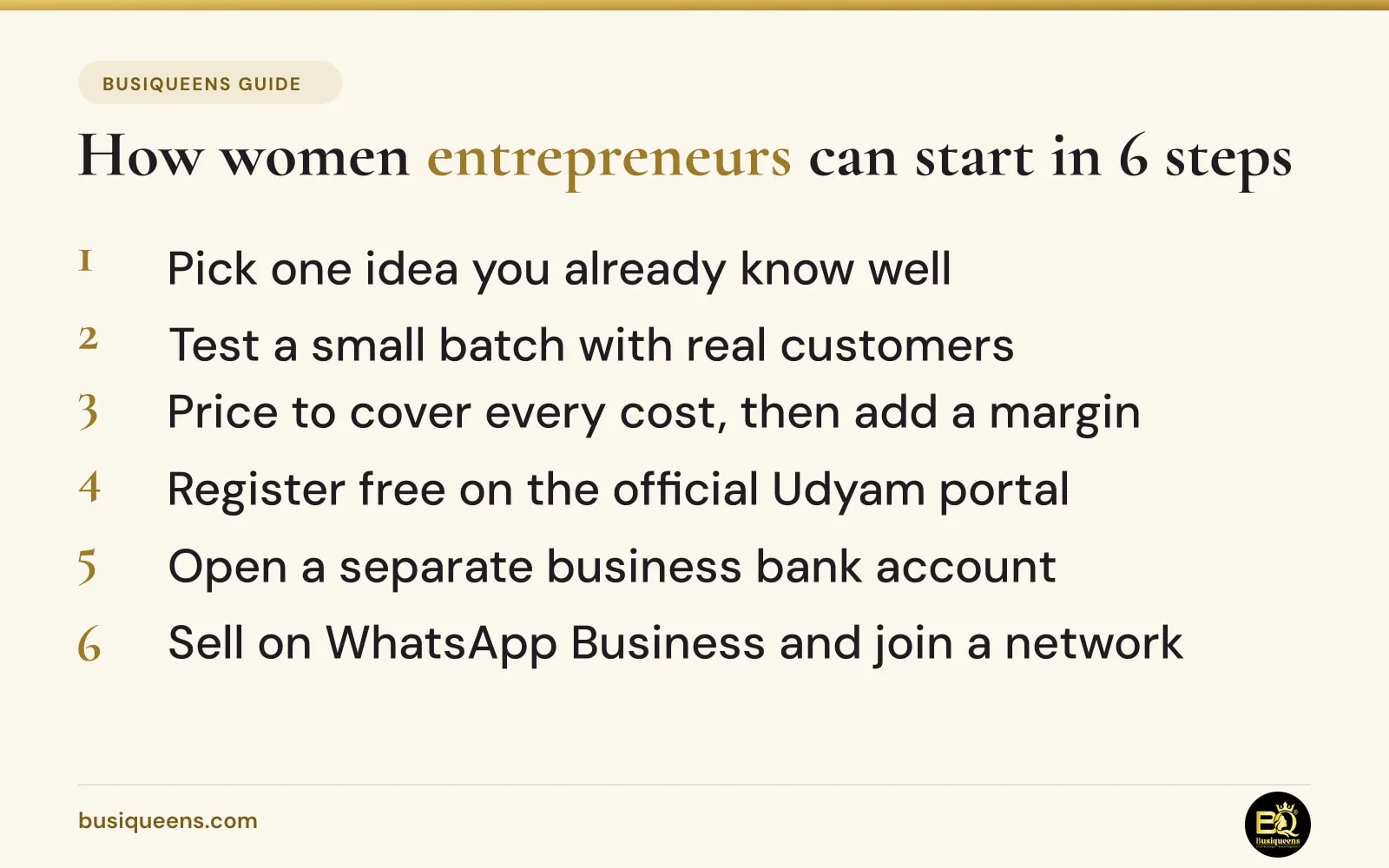
- Pick one idea you can start this month. Choose something you already know, like cooking, stitching, teaching or beauty, and that people around you will pay for.
- Test it with real customers. Sell a small batch to friends, neighbours or office colleagues and ask for honest feedback.
- Fix your price properly. Add up materials, packaging, delivery and your time, then add a margin. Do not price only to beat others.
- Register the business. Do Udyam registration on the official portal, open a separate business bank account and take any licence your trade needs.
- Set up simple selling tools. A WhatsApp Business catalogue, a UPI QR code and an Instagram or Facebook page are enough to begin.
- Keep records from day one. Note every sale and every expense in a notebook or a free app.
- Join a network. Find women entrepreneurs near you for referrals, advice and courage.
- Grow slowly and borrow wisely. Take a loan only for something that will clearly earn back more than it costs, and only after talking to your bank or a qualified advisor.
How can women entrepreneurs find their first customers?
Your first customers are usually people who already know and trust you. Friends, neighbours, relatives, colleagues and the parents in your child’s school group are a natural first market.
Tell them clearly what you sell, the price and how to order. A short WhatsApp message with a photo, a price and a delivery day works better than a long, vague post. Ask every happy customer to share a photo or a line of feedback, and to tell one friend.
Next, go where your buyers already gather. Local exhibitions, society events, festival melas, school fairs and community groups bring many buyers to one place. Online, local Facebook groups and Instagram posts tagged with your city help nearby customers find you.
Listing your business in a trusted directory also helps people who search for a product near them. Keep your listing updated with real photos, prices and contact details, and reply to every enquiry quickly. Fast, polite replies win orders more often than lower prices.
Finally, look after repeat customers. A thank-you note, a small festive offer or a reminder when a regular item is due can turn a one-time buyer into a customer for years.
How can women entrepreneurs sell online safely?
Selling online opens a bigger market, but it also brings new risks. A few simple habits keep you and your customers safe.
- Use a business number. A separate WhatsApp Business number keeps orders apart from family chats and protects your privacy.
- Take payment before dispatch for new customers, or use cash on delivery only through a trusted courier.
- Never share OTPs or banking passwords with anyone who claims to be a buyer, a bank or a platform.
- Check payment in your bank app, not from a screenshot the buyer sends, because screenshots can be faked.
- Write clear terms for returns, delivery times and custom orders, and share them before the customer pays.
- Use your own photos of real products. Borrowed images can mislead customers and may break copyright rules.
If you sell through a marketplace, read its seller rules and fee structure on the platform’s own official page before you sign up.
How should women entrepreneurs plan their finances?
Money planning decides whether a small business survives its first difficult year. It does not need to be complicated.
Start with your own funds and early sales. Many women in India begin with savings and grow with the profit from each order. This keeps you in control and avoids debt before you know the business works.
Use formal credit when you are ready. Bank loans under schemes like Mudra can fund equipment or stock. A clean bank record, Udyam registration and a short plan with expected sales help the conversation with your bank.
Look at investors only when the model is proven. Angel investors and venture capital suit fast-growing startups, not most home businesses. If you go this way, practise your pitch, use your network and look for investors who back diverse founders.
Plan for the long term. Set clear money goals, track cash flow every week and keep a small reserve for slow months. Good money habits like budgeting and saving receipts make tax time and loan applications far easier.
For tax, GST or loan decisions, speak to a qualified CA or your bank before you act.
How long does it take to build a steady small business?
There is no fixed timeline, and anyone who promises quick riches is not being honest with you. Registration on the official Udyam portal is online and can be done early, but building regular customers takes much longer.
For most home businesses, the first few months are about testing products, prices and selling channels. Repeat customers usually come only after people have tried you more than once and recommended you to others.
The best time to start is when you have a small budget you can afford to risk, a little fixed time each day and the support of at least one person at home. Start small, review every month and grow what works.
What mistakes should new women entrepreneurs avoid?
These are the common mistakes that cost women entrepreneurs time and money:
- Paying agents for free services. Udyam registration is free on the official portal. Be wary of anyone who asks for a fee to register you or to get a loan approved.
- Mixing business and household money. Without a separate account, you cannot tell whether the business is earning.
- Underpricing. Selling below cost to win customers drains your savings and is hard to undo later.
- Skipping licences. Food, cosmetics and some other trades need registrations. Check the official portal for your trade.
- Borrowing too early. A loan taken before the product is tested can become a burden.
- Trying to do everything alone. Ask for help at home, outsource small tasks and lean on your network.
- Trusting forwarded messages. Scheme details on WhatsApp forwards are often wrong. Confirm on the official government site.
- Not chasing late payments. Give clear payment terms, send polite reminders and keep a record of who owes what.
- Copying others too closely. Learn from successful sellers, but build your own products, photos and voice.
What does the future hold for women entrepreneurs?
Several trends point to more opportunity for women entrepreneurs in the years ahead. Digital selling, online payments and social media keep lowering the cost of starting a business, especially from home.
Women are also building businesses in health, education, food, sustainable products and technology. According to PIB (17 April 2026), more than 1.07 lakh recognised startups have at least one woman director or partner, about 48% of the total, which shows how many women are now part of India’s startup story.
To keep this going, the next generation needs support early. Schools, mentoring programmes and business communities that build confidence, money skills and leadership in young women will shape the women entrepreneurs of tomorrow.
Busiqueens celebrates women in business every year at the Busiqueens Awards, where you can see the current edition, the nominees and past winners.
Where Busiqueens fits in
Busiqueens is a community and business platform for women entrepreneurs, founded by Atoofa Khushnood in Kolkata. You can list your business in the verified directory of women-led businesses, read real stories of members who started small, and share yours with us.
For daily questions, referrals and encouragement, join women entrepreneurs from across India in the Busiqueens Facebook group.
Conclusion
Women entrepreneurs in India have come a long way, and most of their work still happens in small units that deserve more support. Finance, time and networks remain the main hurdles, but free registration, collateral-free credit schemes, digital tools and communities make the first steps easier than before. Start small, stay registered and honest, and keep learning.
- Check every scheme detail on the official portal before you apply.
- Register on Udyam for free and keep business money separate from day one.
- Build a network of women who will buy from you, refer you and guide you.
Sources and references
- Ministry of Statistics and Programme Implementation (MoSPI), Sixth Economic Census, Chapter VI Women Entrepreneurs: https://www.mospi.gov.in/sites/default/files/economic-census/sixth_economic_census/all_india/11_ChapterVI_6ecRep_0.pdf, checked 20 November 2026
- NITI Aayog, Decoding Government Support to Women Entrepreneurs in India: https://www.niti.gov.in/sites/default/files/2023-03/Decoding-Government-Support-to-Women-Entrepreneurs-in-India.pdf, checked 20 November 2026
- Press Information Bureau, Ministry of Finance, Pradhan Mantri Mudra Yojana completes 11 years (8 April 2026): https://www.pib.gov.in/PressReleasePage.aspx?PRID=2249915, checked 20 November 2026
- Press Information Bureau, Cabinet approves Continuation of Stand-Up India Scheme (11 November 2026): https://www.pib.gov.in/Pressreleaseshare.aspx?PRID=2334978, checked 20 November 2026
- Department of Financial Services, Ministry of Finance, Stand-Up India Scheme page: https://financialservices.gov.in/stand-india-scheme-supi, checked 20 November 2026
- Press Information Bureau, Startup India recognitions in FY 2025-26 (17 April 2026): https://www.pib.gov.in/PressReleasePage.aspx?PRID=2253019, checked 20 November 2026
- Press Information Bureau, Ministry of MSME, Udyam Registration and Udyam Assist (14 July 2026): https://www.pib.gov.in/PressReleasePage.aspx?PRID=2284414, checked 20 November 2026
- Ministry of MSME, Udyam Registration portal: https://udyamregistration.gov.in/, checked 20 November 2026
Frequently asked questions
How many women entrepreneurs are there in India?
There is no single official count. The Sixth Economic Census (MoSPI) found 8.05 million establishments run by women, about 13.76% of the total. NITI Aayog's research says women own about 20% of enterprises. PIB reports that more than 1.07 lakh recognised startups have at least one woman director or partner.
What is women entrepreneurship in India?
It means women starting, owning and running their own businesses, from a home tiffin service or boutique to a technology startup. According to NITI Aayog, 82% of women-led enterprises in India are micro units run as sole proprietorships, many of them informal and home-based.
What are the biggest challenges women entrepreneurs face in India?
The most common hurdles are access to working capital, bias about women's ability to lead, the double load of business and housework, small networks and limited mobility. Many women also lack property for collateral or a credit history, which keeps most women-owned units micro.
Which government schemes support women entrepreneurs in India?
Key central options include free Udyam registration, Pradhan Mantri Mudra Yojana loans up to Rs 20 lakh as per PIB, Stand-Up India loans above Rs 10 lakh and up to Rs 1 crore for new enterprises, and NITI Aayog's Women Entrepreneurship Platform. States add their own schemes. Confirm details on the official site.
Is Stand-Up India still open in 2026?
According to a PIB release dated 11 November 2026, the Union Cabinet approved the continuation of Stand-Up India for 5 years up to 31 March 2031. It supports loans above Rs 10 lakh and up to Rs 1 crore for new enterprises of women, SC and ST entrepreneurs. Ask your bank branch for current terms.
What share of Mudra loans go to women?
As per a Press Information Bureau release of 8 April 2026, women make up 67% of Pradhan Mantri Mudra Yojana loan beneficiaries. Mudra offers collateral-free institutional credit up to Rs 20 lakh for non-corporate, non-farm income-generating activities through banks, NBFCs and microfinance institutions.
Is Udyam registration free for women entrepreneurs?
Yes. The official Udyam Registration portal of the Ministry of MSME says registration is free of cost and paperless, and that no private agency or person is authorised to do it. Register only on udyamregistration.gov.in and never pay an agent a fee for it.
How can a woman start a business from home in India?
Pick one idea you already know, test it with a small batch, price it to cover all costs, register on the free Udyam portal, open a separate business bank account, take any licence your trade needs and sell through WhatsApp Business and local groups. Keep records from the first day.
Do women entrepreneurs need a loan to start?
Not always. Many home businesses in India start with savings and grow from the profit of early orders. Borrow only when a clear use will earn back more than the loan costs, and speak to your bank or a qualified advisor before you apply for any scheme.
How does Busiqueens help women entrepreneurs?
Busiqueens is a community and business platform for women entrepreneurs, founded by Atoofa Khushnood in Kolkata. Members can list their business in a verified directory, join the Facebook group for advice and referrals, read member stories and take part in meetups and the Busiqueens Awards.