
How to Start a Home Bakery Business in India (2026 Guide)
Start a home bakery business in India: real costs, FSSAI registration under the 2026 rules, pricing from cost and how to win your first ten orders.
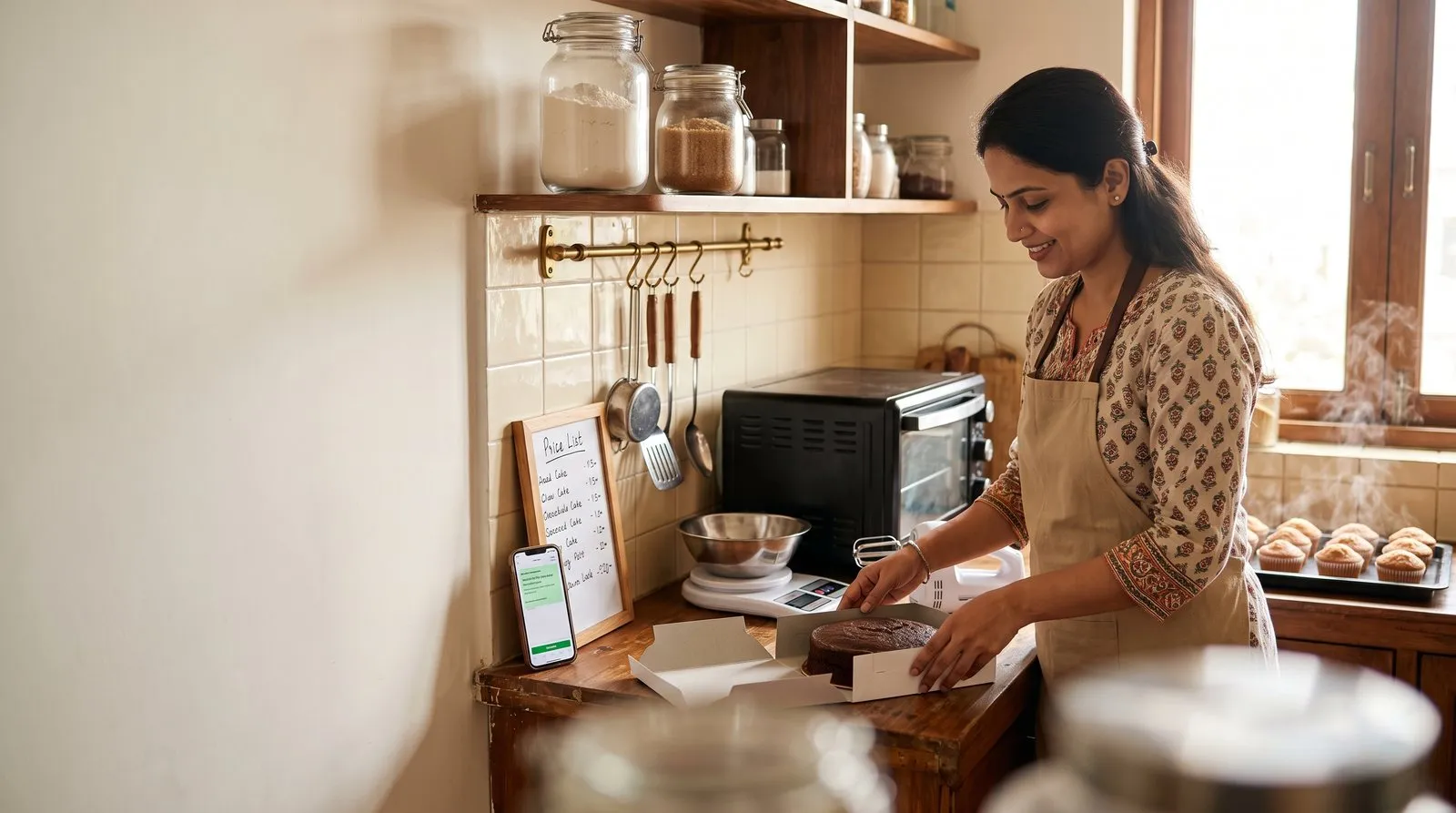
To start a home bakery business in India you need four things: an oven and basic tools (about Rs 15,000 to 40,000 if you own nothing yet), an FSSAI registration before your first paid order, a price list built on your real ingredient cost, and ten first customers you can already name. Everything else can wait until orders come in.
The registration rules changed this year. According to an FSSAI order dated 13 March 2026, food businesses with turnover up to Rs 1.5 crore a year need only an FSSAI registration from 1 April 2026, not a licence. The old limit of Rs 12 lakh that many blogs still quote no longer applies to new applications.
Below: the kit, the FSSAI steps, pricing and the first orders, with numbers from the Busiqueens community.
Last updated: 13 November 2026.
What is a home bakery business, and is it a good idea in India?
A home bakery business is a food business run from your own kitchen: cakes, cupcakes, cookies, brownies, breads or festive hampers, made to order and sold to customers you reach through WhatsApp, Instagram, word of mouth and local listings. You bake at home, so there is no shop rent, and you can start small and grow order by order.
It is a good idea for a woman who already bakes well and can give it regular hours. Demand is steady all year, because birthdays never stop, and it rises in the wedding season, around Diwali and the festive quarter, at Christmas and New Year, and at Eid. Customers in every Indian city now expect to find a home baker in their neighbourhood.
The trade-offs are honest ones. It is physical work at odd hours, the margin on a plain cake is modest until you add design or volume, and the kitchen is shared with the family. Bakers who last treat it as a business from the first order: a price list, an order book, a delivery rule and a day off.
Who should start a home bakery business?
- Women who already bake for family and friends and get asked, again and again, to make the birthday cake.
- Homemakers and mothers who want income on their own hours, with orders planned around school and family time.
- Working women who want a weekend side business before deciding whether to make it full time.
- Women in smaller towns, where a reliable home baker often has less competition than in the metros.
What will a home bakery business get you?
Income, first, though it depends on your prices, hours and city, so treat this as arithmetic, not a promise.
A baker taking 10 to 15 orders a week at an average of Rs 1,000 turns over Rs 40,000 to 60,000 a month. If ingredients and packaging take 35 to 45% of the price, that leaves roughly Rs 20,000 to 35,000 before gas, electricity and delivery. Bakers who under-price stay stuck at the first number however hard they work.
It also gets you a business you own: regular customers, a name in your locality and skills that can grow into classes or corporate gifting later.
What do you need to start a home bakery, and what does it cost?
You need less than the shopping lists online suggest. The table shows the kit most members start with. These are typical ranges reported by members and suppliers in Indian cities, not fixed prices; check current prices in your city. Buy the oven and the scale new; everything else can be second-hand or borrowed for the first month.
| Item | Typical cost | Note |
|---|---|---|
| OTG or convection oven (30 to 45 litres) | Rs 8,000 to 15,000 | The one purchase not to skimp on |
| Hand mixer or stand mixer | Rs 1,500 to 3,000 (hand); Rs 8,000 and up (stand) | Start with a hand mixer |
| Digital weighing scale | Rs 300 to 800 | Bake by weight, not cups |
| Cake tins, cupcake trays, moulds | Rs 1,500 to 3,000 | 6, 7 and 8 inch rounds cover most orders |
| Turntable, spatulas, piping bags and nozzles | Rs 800 to 1,500 | Buy more nozzles as your designs grow |
| First 100 boxes, boards, labels and ribbon | Rs 1,500 to 3,000 | Print your FSSAI number on the label |
| First month of ingredients | Rs 3,000 to 6,000 | Buy per order until you know your best sellers |
| FSSAI registration | Rs 100 a year (FSSAI eligibility table) | Applied for online on FoSCoS |
| Total | Rs 15,000 to 40,000 | Under Rs 10,000 if you own an oven |
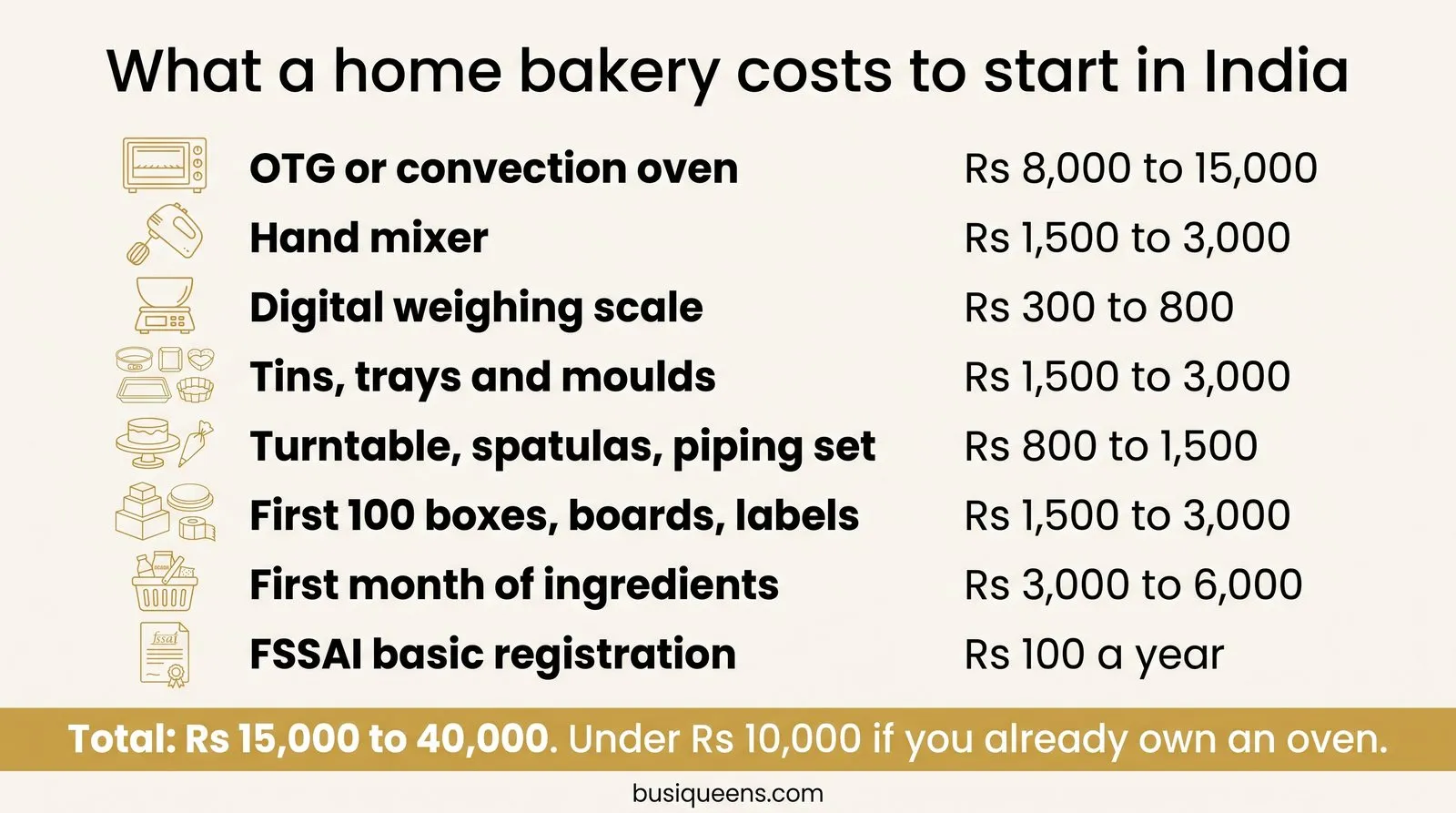
A stand mixer, a second oven and a chest freezer are second-year purchases, paid for by the business.
List your business on Busiqueens
Get a verified business page with your photos, services and a WhatsApp button, so customers in Kolkata and across India can find and contact you.
Rs 999, paid only after your listing is approved.
List your businessEvery listing is checked by our team before it goes live.
Do home bakers need FSSAI registration in 2026?
Yes. Selling food, even from a home kitchen, makes you a food business operator under the Food Safety and Standards Act, 2006, so you need to be registered with FSSAI before you sell. What changed in 2026 is which category you fall into.
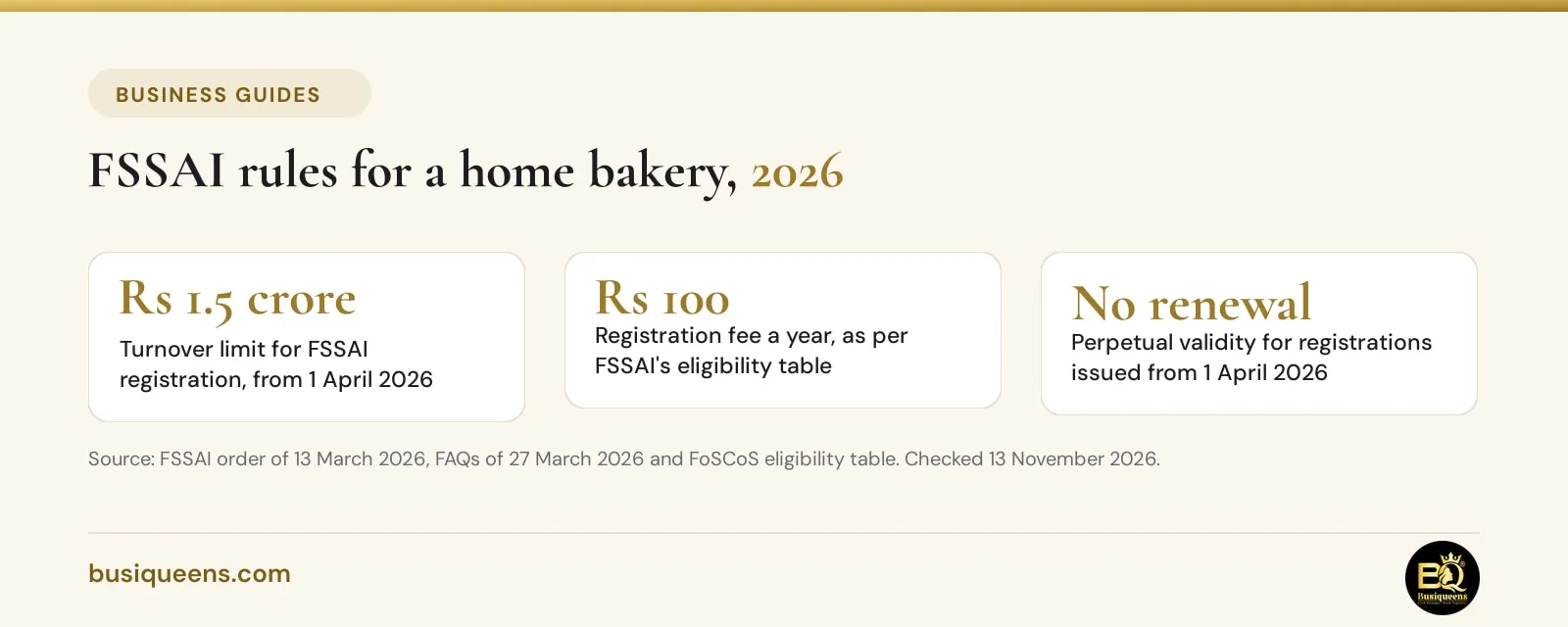
- Registration up to Rs 1.5 crore. According to the FSSAI order of 13 March 2026, registration covers turnover up to Rs 1.5 crore, a state licence covers turnover above Rs 1.5 crore and up to Rs 50 crore, and a central licence applies above Rs 50 crore, effective from 1 April 2026.
- Bakery wares are covered. FSSAI’s kind of business eligibility table (updated 1 April 2026) lists bakery wares under general manufacturing, with registration for annual turnover up to Rs 1.5 crore at a fee of Rs 100 a year, and a state licence above that at Rs 5,000 a year.
- No renewals for new registrations. FSSAI’s FAQs dated 27 March 2026 say a licence or registration issued on or after 1 April 2026 has perpetual validity, remaining valid unless suspended, cancelled or surrendered, and that fees can be paid for any number of years at once.
- Existing holders can move down. The same FAQs say existing businesses will get time to migrate on FoSCoS, the migration has no fee, and the registration number does not change.
For almost every home baker, that means the simple FSSAI registration, not a licence. If you hold an older registration or licence, read the FAQs and confirm your case with your district food safety office before you change anything.
How do you start a home bakery business, step by step?
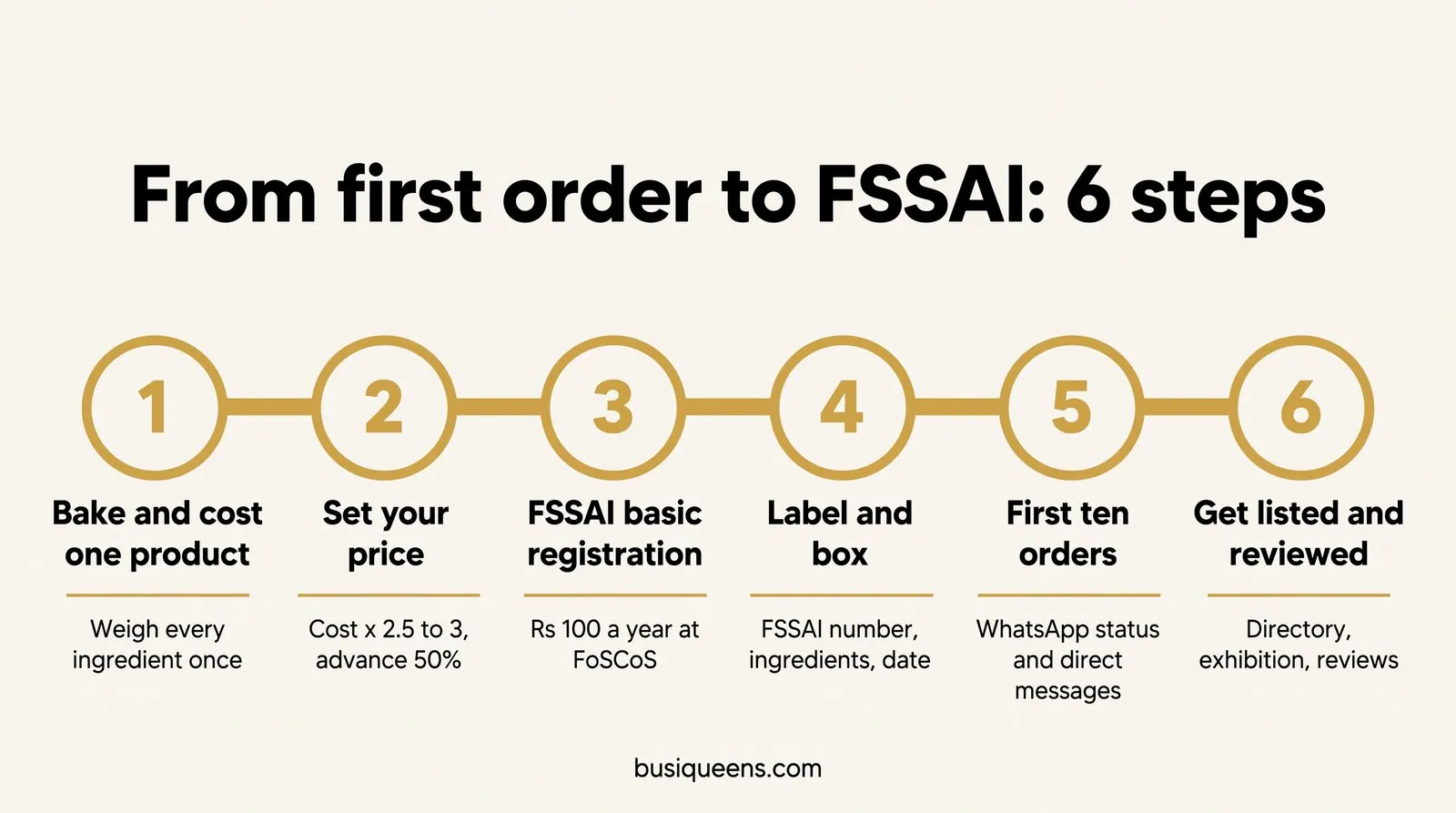
- Perfect one product. Bake your best seller until it comes out the same every time, and weigh every ingredient so you know its exact cost.
- Get your FSSAI registration. Go to the official portal, foscos.fssai.gov.in, choose the registration option for your state, and select the kind of business that matches what you make. FoSCoS shows the documents and fee for your case before you pay. Keep a photo, a photo ID and proof of your address scanned and ready.
- Register on Udyam if you want MSME recognition. The Udyam portal says registration is free of cost and paperless, and warns users to beware of fake sites. Never pay an agent for it.
- Set your price list from your real costs (see the next section) and save it as one image on your phone.
- Prepare labels and boxes. Show your business name, the product, the ingredients, any allergens such as wheat, dairy, eggs or nuts, the veg mark, a best-before date and your FSSAI number. Check FSSAI’s current labelling rules or ask your local food safety office before you print in bulk.
- Take your first ten orders from people who already trust you, then ask each one for a photo and a review.
- Separate your money. Open a separate bank account or UPI ID from month one so you can see what the bakery really earns. For GST and income tax questions, speak to a qualified CA; the answer depends on your turnover, where you sell and whether you sell through apps.
How much should a home baker charge?
Price from cost, not from what the baker down the road charges. Work out the ingredient cost of one product by weighing every input once, add packaging, and multiply. Most home bakers land between 2.5 and 3 times the ingredient plus packaging cost for cakes, and higher for detailed design work, which is really paid in hours.
A worked example: a one-kilo chocolate truffle cake might use about Rs 350 of ingredients in a metro (flour, cocoa, butter or oil, eggs, sugar, cream, chocolate) and Rs 40 of box and board. Cost Rs 390; a price of Rs 1,000 to 1,200 leaves Rs 600 to 800 for your time, gas, electricity and the orders that go wrong. Your own numbers will differ, so weigh and check them.
Three rules members swear by: take a 50% advance on custom cakes, add a delivery charge instead of hiding it in the price, and raise prices once a year in a message to regulars rather than silently.
How do you get your first ten orders?
- Bake for the people who already trust you. Post one product on your WhatsApp status every day for two weeks, with the price and a clear order cut-off such as Thursday for the weekend.
- Message ten people directly, one by one, and offer a small tasting box at cost. Ask each buyer for one photo and one line of feedback you can share.
- Use the groups you are in: the school parents, the housing society, the office group where the rules allow it. Birthday cakes for children are often the most reliable first orders.
- Get listed where customers search. A verified Busiqueens listing puts you on the Home Bakers page by city, at Rs 999 a year paid after approval, with a certificate and a QR code for your boxes.
- Take one exhibition stall in year one. Members who take a stall at Busiqueens exhibitions often meet repeat customers and corporate gifting enquiries there.
- Post Instagram reels of the process, not only the finished cake. The layering, the piping and the box going out of the door build trust faster than a perfect photo.
When should you register, and how long does it take to start?
Register with FSSAI before your first paid order, not after. Selling to customers outside your family is what makes you a food business, and a registration number on your label also tells customers you are serious.
A realistic timeline:
- Weeks 1 to 2: test and cost your first three products, buy the kit you are missing, and apply for FSSAI registration on FoSCoS.
- Weeks 3 to 4: print labels, set your price list and take your first orders from your own circle.
- Months 2 to 3: add a listing, collect reviews and decide your weekly order limit.
- Before the festive or wedding season: plan hampers and bulk orders a month ahead, because that is when demand rises.
Track your application status on FoSCoS itself; do not pay anyone to follow up.
What mistakes should new home bakers avoid?
- Selling below cost because a relative would not pay that much. Your relatives are not your market.
- Following old FSSAI advice. Many pages still quote the Rs 12 lakh limit. Check the 2026 order on the official FSSAI site before you choose a category.
- Paying agents for free or cheap registrations. Udyam is free on its official portal, and FSSAI registration is applied for on FoSCoS. Be careful with lookalike websites.
- Taking every order. Set a weekly limit and a cut-off day; sold out is a good sign.
- No advance, no written order. A voice note is not an order; a message with the date, size, flavour, price and advance is.
- Mixing business and household money. A separate account shows you what the bakery really earns.
Busiqueens members who bake
Several home bakers are among the nominees of the Busiqueens Awards 2026, each with a public page and customer reviews: Shagufta Nazrul of The Real Cakes by Shagufta, Zaira Hossain of The Cupcake Darling, Afifa Parween of The Baker’s Zia, Ibtasha Iqbal of Dessert Dairy and Farheen Perveen of F7 Cake and More. Their pages are a good way to see what a working home bakery in India looks like today.
Where Busiqueens fits in
Busiqueens is India’s community and verified business directory for women entrepreneurs, founded in Kolkata in 2021 by Atoofa Khushnood. Home bakers list on the Home Bakers page, customers back them with reviews, and members meet at exhibitions, the awards night and in the Busiqueens Facebook group. If you are still choosing between ideas, read our guides to 25 small business ideas for women in India and business ideas for women at home. If baking is your business already, list it on Busiqueens.
Conclusion
A home bakery is cheap to start and easy to run badly. The women who make it work do three things early.
- Register first: FSSAI registration on FoSCoS before the first paid order, using the 2026 rules, and Udyam free on its official portal if you want it.
- Price from cost: weigh the ingredients once, multiply by 2.5 to 3, take an advance and charge for delivery.
- Sell to your own circle first: WhatsApp status, ten direct messages, one listing, one exhibition and a review from every happy customer.
Sources and references
- Food Safety and Standards Authority of India (FSSAI), Order on revised turnover threshold dated 13 March 2026: https://www.fssai.gov.in/upload/advisories/2026/03/69b4054bb6cd6Order%20dated%2013thMarch2026_Revised%20Turnover%20threshold.pdf, checked 13 November 2026
- Food Safety and Standards Authority of India (FSSAI), FAQs on the Licensing and Registration Amendment Regulations 2026, dated 27 March 2026: https://fssai.gov.in/upload/advisories/2026/03/69c6a23234827order_27032026.pdf, checked 13 November 2026
- FSSAI FoSCoS, Kind of business eligibility and fee table, updated 1 April 2026: https://foscos.fssai.gov.in/assets/docs/Revised_2ndApril2026KindofBusinessEligibility.pdf, checked 13 November 2026
- FSSAI, Food Safety Compliance System (FoSCoS) portal for registration: https://foscos.fssai.gov.in/, checked 13 November 2026
- Ministry of MSME, Udyam Registration portal: https://udyamregistration.gov.in/, checked 13 November 2026
- The Hindu, report on the FSSAI amendments and revised turnover limits, 6 April 2026: https://www.thehindu.com/news/national/karnataka/mysuru-hotels-welcome-amendments-to-fssai-that-grant-lifetime-validity-for-licence-update-on-turnover-limits/article70829751.ece (media, for context), checked 13 November 2026
Frequently asked questions
Do home bakers need FSSAI registration in India?
Yes. Anyone who sells food, even from a home kitchen, needs to be registered with FSSAI before selling. Under FSSAI's order of 13 March 2026, businesses with turnover up to Rs 1.5 crore a year fall in the registration category from 1 April 2026, so most home bakers need the simple registration, applied for on FoSCoS, not a licence.
What is the FSSAI registration fee for a home bakery in 2026?
FSSAI's kind of business eligibility table, updated 1 April 2026, lists the registration fee as Rs 100 a year for general manufacturing, which includes bakery wares, up to Rs 1.5 crore turnover. FSSAI's FAQs say fees can be paid for any number of years at once. Confirm the exact fee on FoSCoS before you pay.
Has the FSSAI Rs 12 lakh limit changed?
Yes. FSSAI's order dated 13 March 2026 replaced the old turnover thresholds from 1 April 2026: registration up to Rs 1.5 crore, a state licence above Rs 1.5 crore and up to Rs 50 crore, and a central licence above Rs 50 crore. Pages that still quote Rs 12 lakh are out of date.
Do I need to renew my FSSAI registration every year?
According to FSSAI's FAQs dated 27 March 2026, a licence or registration issued on or after 1 April 2026 has perpetual validity and stays valid unless it is suspended, cancelled or surrendered, so it does not need renewal. You must still follow hygiene and safety rules. Holders of older registrations should check their case on FoSCoS.
How much does it cost to start a home bakery business in India?
Typically Rs 15,000 to 40,000 for an OTG oven, a hand mixer, a scale, tins, the first hundred boxes and a month of ingredients, plus the FSSAI registration fee. These are typical ranges reported by members and suppliers, and prices vary by city. If you already own an oven, many bakers open for under Rs 10,000.
Is a home bakery business profitable in India?
It can be, if you price from cost. A baker doing 10 to 15 orders a week at about Rs 1,000 each turns over Rs 40,000 to 60,000 a month; if ingredients and packaging take 35 to 45% of that, roughly Rs 20,000 to 35,000 is left before gas, electricity and delivery. This is arithmetic, not a promise.
How do I price a cake from home?
Weigh every ingredient in one cake once, add the box and board, and multiply the total by 2.5 to 3. A one-kilo chocolate cake that costs about Rs 390 to make would be priced at Rs 1,000 to 1,200. Take a 50% advance on custom orders and charge delivery separately so your margin stays clear.
Is Udyam registration free for a home bakery?
Yes. The official Udyam portal, udyamregistration.gov.in, says Udyam (MSME) registration is free of cost and paperless, and warns people to beware of fake sites. It is optional for a home baker but useful for MSME recognition. Never pay an agent or a lookalike website for it.
Do I need GST for a home bakery?
It depends on your turnover, whether you sell within your state or across states, and whether you sell through apps or marketplaces, which often ask for a GSTIN before onboarding. Rules and thresholds can change, so check with a qualified CA before you register or decide not to register.
How do I get my first customers for a home bakery?
Start with people who already trust you: post one product a day on your WhatsApp status for two weeks, message ten people directly with a tasting offer, use the school and society groups that allow it, get a verified listing where customers search by city, and take one exhibition stall in your first year.