How to Start a Home Bakery Business in India (2026 Guide)
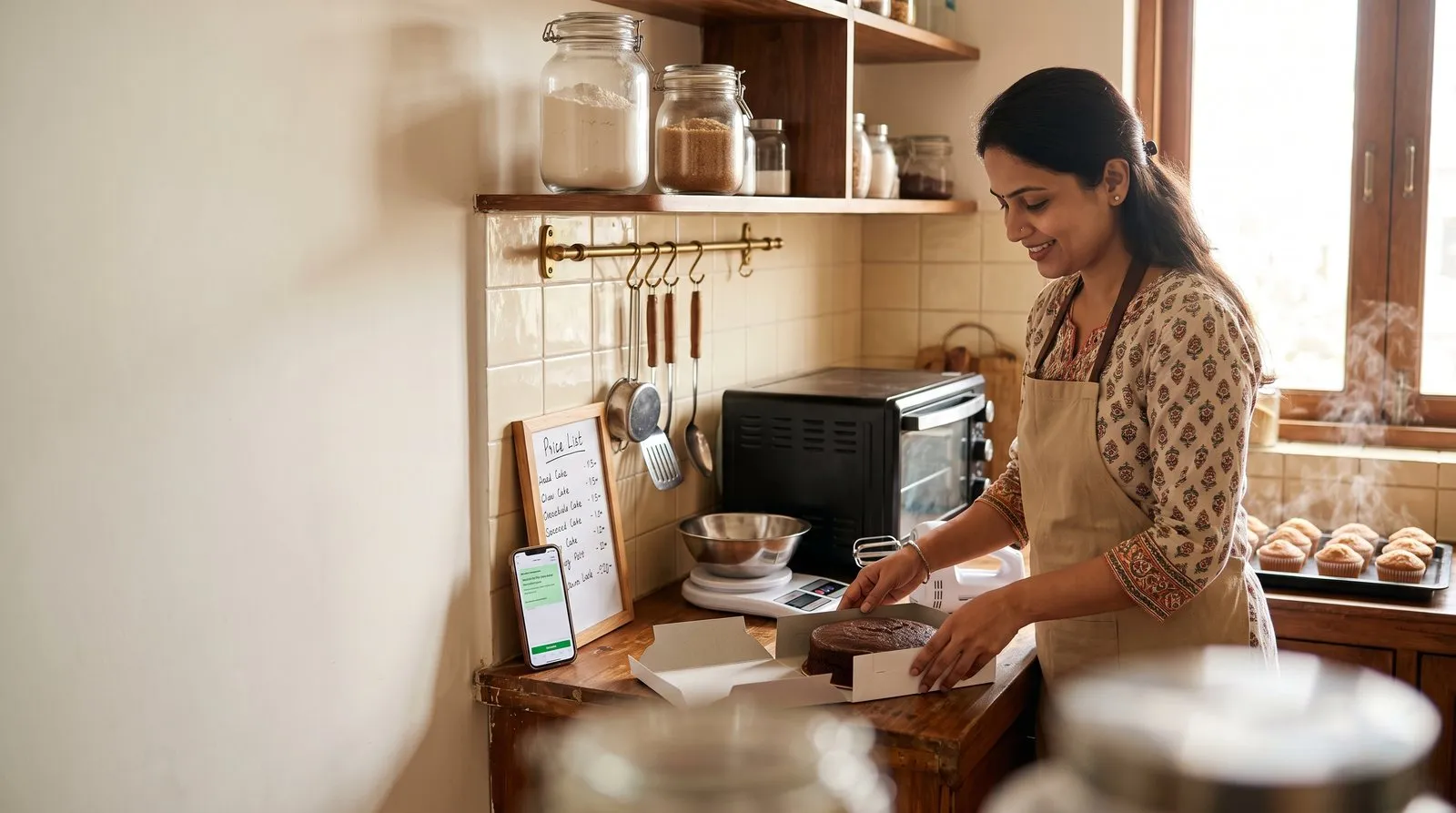
To start a home bakery business in India you need four things: an oven and basic tools (about Rs 15,000 to 40,000 if you own nothing yet), an FSSAI basic registration (Rs 100 a year, online, usually issued within a week), a price list built on your real ingredient cost, and ten first customers you can already name. Everything else, from a brand name to a trademark, can wait until the orders are coming in.
This guide walks through those four things in order, with the numbers home bakers in the Busiqueens community actually work with, the FSSAI steps and label rules in plain words, a pricing method you can do on a phone calculator, and the routes that bring the first orders. Costs are typical ranges reported by members and suppliers in Indian cities in September 2026; yours will move with your city and your choices.
Home baking is the single biggest business type among women in our community, and seven of the 54 nominees in the Busiqueens Awards 2026 are bakers. They started the way this guide describes.
Is a home bakery a good business in India?
Yes, for a woman who already bakes well and can give it regular hours. Demand is steady all year (birthdays never stop) and peaks four times: the wedding season, Diwali and the festive quarter, Christmas and New Year, and Eid. Customers in every Indian city now expect a home baker to exist in their neighbourhood, and they find her through WhatsApp, Instagram and word of mouth rather than a shop.
The trade-offs are honest ones. It is physical work at odd hours, the margin on a plain cake is modest until you add design or volume, and the kitchen is shared with the family. Bakers who last treat it as a business from the first order: a price list, an order book, a delivery rule, and a day off.
What do you need to start, and what does it cost?
You need less than the shopping lists online suggest. The table below is the kit most members start with. Buy the oven and the scale new; everything else can be second-hand or borrowed for the first month.
| Item | Typical cost | Note |
|---|---|---|
| OTG or convection oven (30 to 45 litres) | Rs 8,000 to 15,000 | The one purchase not to skimp on |
| Hand mixer or stand mixer | Rs 1,500 to 3,000 (hand); Rs 8,000+ (stand) | Start with a hand mixer |
| Digital weighing scale | Rs 300 to 800 | Bake by weight, not cups |
| Cake tins, cupcake trays, moulds | Rs 1,500 to 3,000 | 6, 7 and 8 inch rounds cover most orders |
| Turntable, spatulas, piping bags and nozzles | Rs 800 to 1,500 | |
| First 100 boxes, boards, labels and ribbon | Rs 1,500 to 3,000 | Print your FSSAI number on the label |
| First month of ingredients | Rs 3,000 to 6,000 | Buy per order until you know your best sellers |
| FSSAI basic registration | Rs 100 a year | Pay for 1 to 5 years at once |
| Total | Rs 15,000 to 40,000 | Under Rs 10,000 if you own an oven |
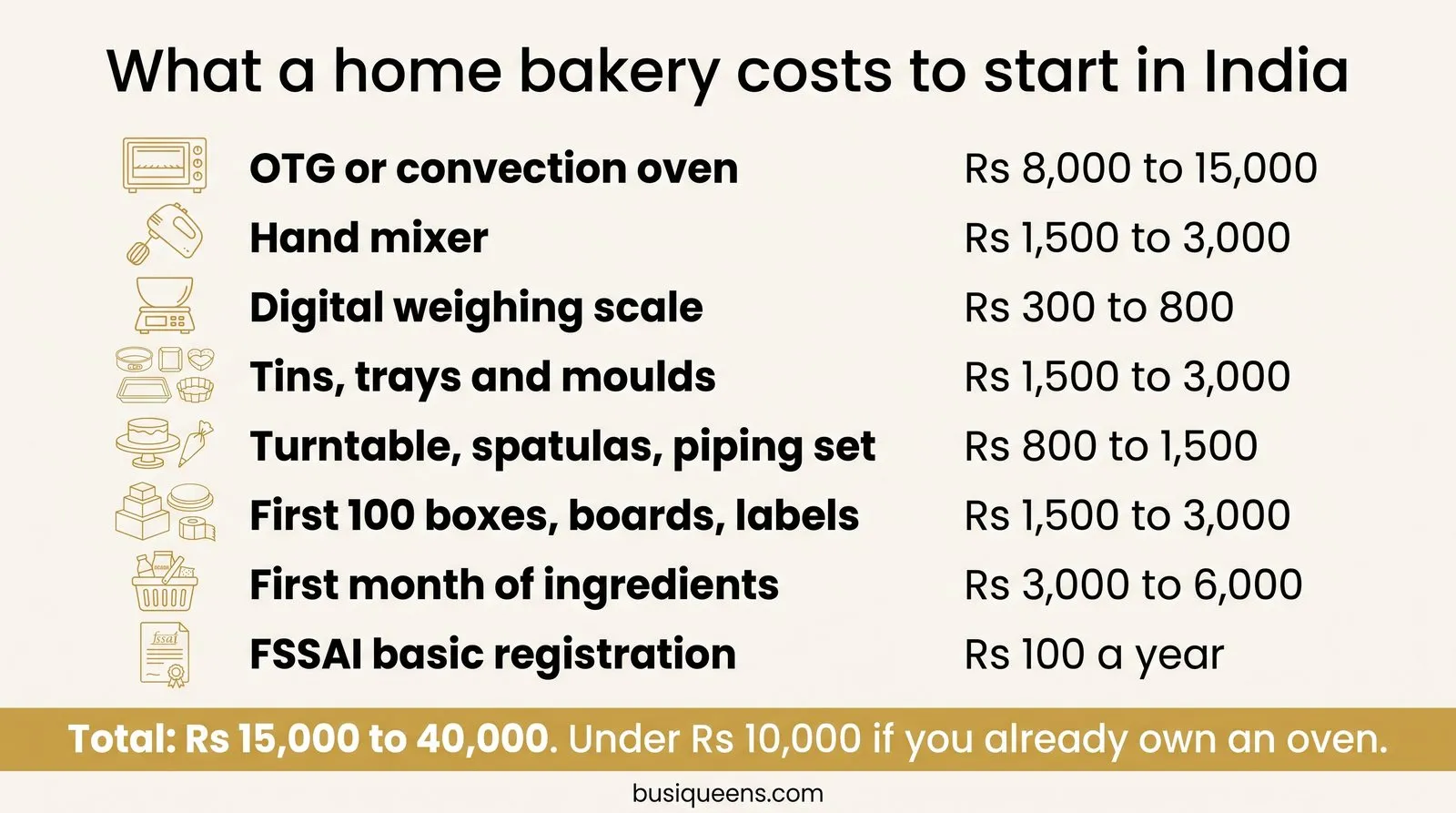
Members who own an oven typically spend under Rs 10,000 to open, and most of that on packaging and the first ingredients. A stand mixer, a second oven and a chest freezer are second-year purchases, paid for by the business.
Do home bakers need an FSSAI licence in India?
Yes. The moment you sell a cake to anyone outside your family, you are a food business operator under the Food Safety and Standards Act, and you need to be registered. For a home bakery with turnover under Rs 12 lakh a year, that means the FSSAI basic registration, not the state or central licence. It costs Rs 100 a year and you can pay for one to five years at once.
How to get FSSAI basic registration for a home bakery
- Keep four things ready: a passport photo, your Aadhaar or another photo ID, a proof of your home address (electricity bill or rent agreement), and a list of what you will sell (“cakes, cupcakes, cookies, brownies”).
- Go to foscos.fssai.gov.in, choose Apply for New Licence or Registration, and select your state and district.
- Under kind of business, pick manufacturer, then the petty food business (registration) category. Fill Form A with your details and product list.
- Upload the documents, pay Rs 100 per year of validity, and save the 17-digit reference number.
- The certificate with your 14-digit registration number usually arrives within a week. Print the number and the FSSAI logo on every label and bill.
What your label must show
Once a cake or a box of cookies is packed, FSSAI labelling rules apply. Keep a simple sticker template with: the product name, the ingredients in descending order by weight, the green or brown veg mark, net weight or number of pieces, best-before date, your business name and address, your FSSAI number with the logo, and an allergen line such as “contains wheat, dairy, eggs and nuts”. Skip health claims like “sugar-free” or “healthy” unless you can prove them.
How much should a home baker charge?
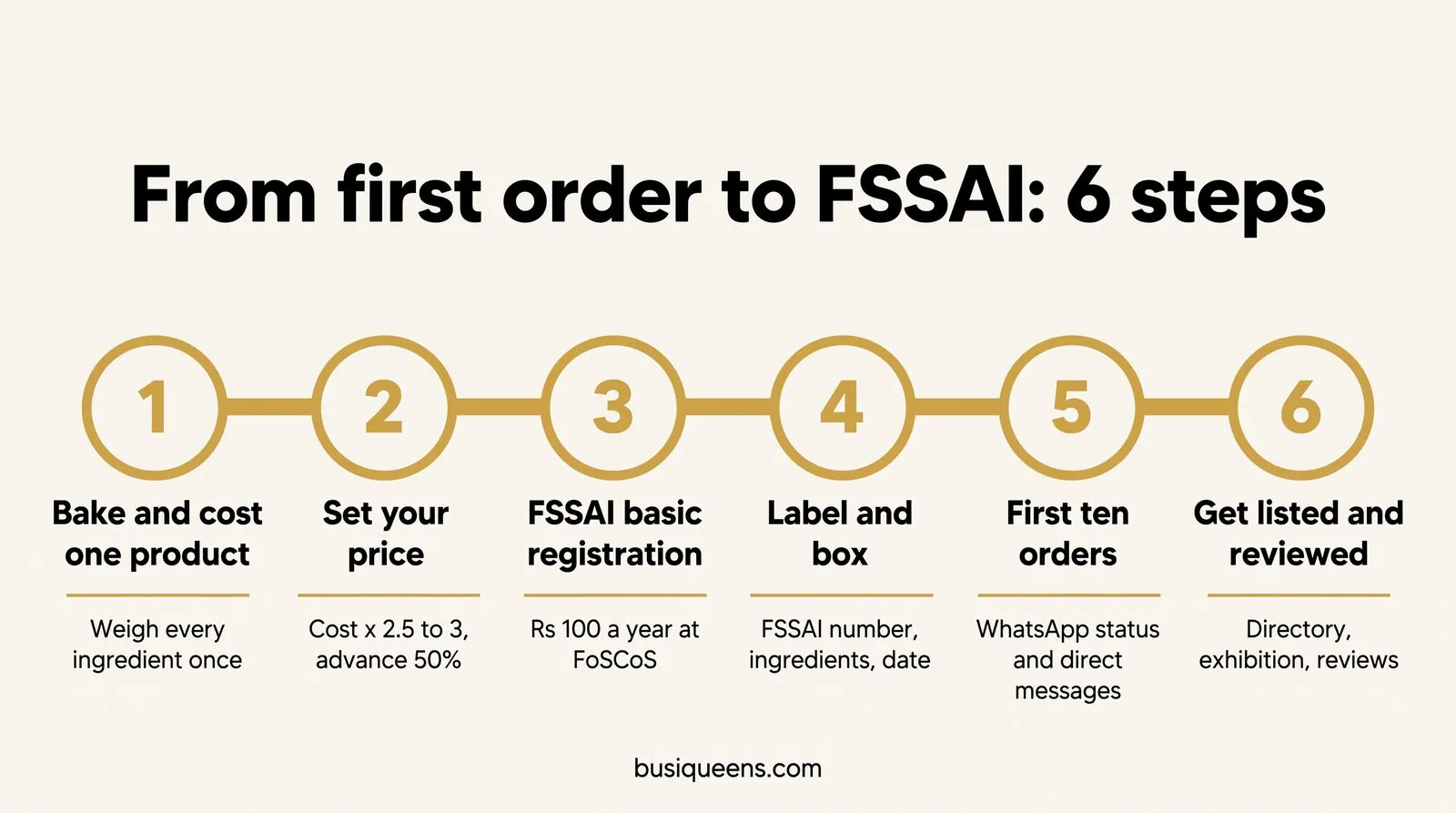
Price from cost, not from what the baker down the road charges. Work out the ingredient cost of one product by weighing every input once, add packaging, and multiply. Most home bakers land between 2.5 and 3 times the ingredient-plus-packaging cost for cakes, and higher for detailed design work, which is really paid in hours.
A worked example: a one-kilo chocolate truffle cake uses roughly Rs 350 of ingredients in most metros in 2026 (flour, cocoa, butter or oil, eggs, sugar, cream, chocolate) and Rs 40 of box and board. Cost Rs 390; a price of Rs 1,000 to 1,200 leaves Rs 600 to 800 for your time, gas, electricity and the orders that go wrong. Cupcakes and brownies price per piece the same way. Put the list in one image on your phone and send it, do not quote from memory.
Three rules members swear by: take 50% advance on custom cakes, add a delivery charge instead of hiding it in the price, and raise prices once a year in a message to regulars rather than silently.
How do you get your first ten orders?
- Bake for the people who already trust you. Post one product on your WhatsApp status every day for two weeks, with the price and “order by Thursday for the weekend”.
- Message ten people directly, one by one, and offer a small tasting box at cost. Ask each buyer for one photo and one line of feedback you can share.
- Use the groups you are in: the school parents, the housing society, the office group where the rules allow it. Birthday cakes for children are the most reliable first orders.
- Get listed where customers search. A verified Busiqueens listing puts you in the Home Bakers page by city for Rs 999 a year, with a certificate and a QR code for your boxes.
- One exhibition in year one. Members who take a stall at AAINA, the Busiqueens exhibition, come back with repeat customers and corporate gifting enquiries that Instagram rarely brings.
- Instagram reels of the process, not only the finished cake. The layering, the piping and the box going out the door build trust faster than a perfect photo.
Our guide on the power of female networking covers how members turn these first contacts into a steady circle of referrals.
How much can a home baker earn?
It depends on your prices, your hours and your city, so treat this as arithmetic, not a promise. A baker taking 10 to 15 orders a week at an average of Rs 1,000 turns over Rs 40,000 to 60,000 a month. With ingredients and packaging at 35 to 45% of the price, that leaves roughly Rs 20,000 to 35,000 before gas, electricity and delivery, and more in the wedding and festive months when custom and bulk orders come in. Bakers who add classes, corporate hampers or a second product line move well beyond this in their second and third years. Bakers who under-price stay stuck at the first number however hard they work.
Common mistakes in the first year
- Selling below cost because a relative “would not pay that much”. Your relatives are not your market.
- Taking every order. Set a weekly limit and a cut-off day; sold out is a good sign.
- No advance, no written order. A voice note is not an order; a message with the date, size, flavour, price and advance is.
- Waiting for the perfect logo before the first sale. Sell first, brand later, trademark when the name is worth protecting (Rs 4,500 per class for an individual or an Udyam-registered business).
- Mixing business and household money. A separate bank account or UPI ID from month one shows you what the bakery really earns.
Busiqueens members who bake
Seven home bakers are nominees in the Busiqueens Awards 2026, most with a public page you can visit: Shagufta Nazrul of The Real Cakes by Shagufta, Zaira Hossain of The Cupcake Darling, Afifa Parween of The Baker’s Zia, Ibtasha Iqbal of Dessert Dairy, Shabnam Ara of Twist and Taste and Farheen Perveen of F7 Cake and More. Their pages carry customer reviews and their Instagram links, which is the best way to see what a working home bakery in India looks like in 2026.
Where Busiqueens fits in
Busiqueens is India’s community and verified business directory for women entrepreneurs, started in Kolkata in 2021. Home bakers list under Food, Bakes and Catering and the Home Bakers type page, customers back them with reviews, and the community brings the exhibitions, the awards night and the Facebook group where members send each other orders they cannot take. If you are still choosing between ideas, our guide to 25 small business ideas for women in India puts home baking next to the alternatives with their real costs. If baking is your business already, list it.
Conclusion
A home bakery is one of the cheapest businesses to start in India and one of the easiest to run badly. The women who make it work do three things early.
- Register first: FSSAI basic for Rs 100 a year before the first paid order, Udyam for free, GST only when the turnover demands it.
- Price from cost: weigh the ingredients once, multiply by 2.5 to 3, take an advance, charge for delivery.
- Sell to your own circle before the internet: WhatsApp status, ten direct messages, one listing, one exhibition, and a review from every happy customer.
Balancing the ovens with the household is its own skill; our members’ advice on balancing work and life as a woman entrepreneur is worth reading before the wedding season arrives.
Sources
- FSSAI Food Safety Compliance System, registration and fee structure: foscos.fssai.gov.in
- FSSAI Food Safety and Standards (Labelling and Display) Regulations, 2020: fssai.gov.in
- Udyam Registration portal, Ministry of MSME: udyamregistration.gov.in
- Pradhan Mantri Mudra Yojana loan categories: mudra.org.in
- GST registration threshold for goods: gst.gov.in
- Trade Marks Rules 2017 fee schedule: ipindia.gov.in
Frequently asked questions
Do home bakers need an FSSAI licence in India?
Yes. Anyone who sells food, even from a home kitchen, must hold at least the FSSAI basic registration. For turnover under Rs 12 lakh a year it costs Rs 100 a year, is applied for online at FoSCoS and is usually issued within a week. Print the 14-digit number on your labels.
How much does it cost to start a home bakery in India?
Typically Rs 15,000 to 40,000 for an OTG, a hand mixer, a scale, tins, the first hundred boxes and a month of ingredients, plus Rs 100 for FSSAI registration. If you already own an oven, most bakers open for under Rs 10,000.
Is a home bakery business profitable in India?
It can be, if you price from cost. A baker doing 10 to 15 orders a week at about Rs 1,000 each turns over Rs 40,000 to 60,000 a month, with ingredients and packaging taking 35 to 45% of that. Festive and wedding months are higher; under-priced bakers earn far less however busy they are.
How do I price a cake from home?
Weigh every ingredient in one cake once, add the box and board, and multiply the total by 2.5 to 3. A one-kilo chocolate cake that costs about Rs 390 to make is priced at Rs 1,000 to 1,200. Take a 50% advance on custom orders and charge delivery separately.
Do I need GST for a home bakery?
Not until your turnover crosses Rs 40 lakh a year for goods, as long as you sell directly through WhatsApp, Instagram or your own page. Marketplaces and food delivery platforms usually ask for a GSTIN before they onboard a seller.
How do I get my first customers for a home bakery?
Start with the people who already trust you: post one product a day on your WhatsApp status for two weeks, message ten people directly with a tasting offer, use the school and society groups that allow it, get a verified listing where customers search by city, and take one exhibition stall in your first year.